North Korean negotiators in spotlight

Cars transporting National Security Office chief Kim Kwan-jin and Unification Minister Hong Yong-pyo head for the truce village of Panmunjeom, Sunday, ahead of a second round of high-level talks with their North Korean counterparts, Hwang Pyong-so and Kim Yang-gon. / Korea Times photo by Bae Woo-han
By Do Je-hae
North Korean negotiators currently engaged in high-level talks between the two Koreas are under keen media scrutiny.
Hwang Pyong-so, the North Korean military's top political officer, and Kim Yang-gon, the top North Korean official in charge of inter-Korean affairs, are in the spotlight again after visiting South Korea for the Incheon Asian Games in October 2014.
Their surprise appearance at the closing ceremony of Asia's largest sporting event failed to produce a meaningful improvement in inter-Korean ties.
South Korean National Security Adviser Kim Kwan-jin and South Korean Unification Minister Hong Yong-pyo met with Hwang and Kim during a closed-door meeting in the border village of Panmunjeom, Sunday.
Hwang, considered to be North Korea's second most important official after Kim Jong-un, appeared at the request of the South Korean government. He is North Korea's highest military authority.
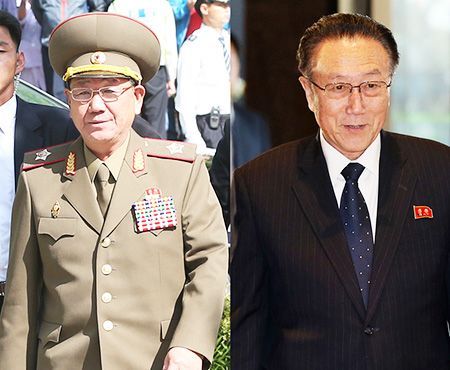
North Korean negotiators to the inter-Korean high-level talks are Hwang Pyong-so, left, top political officer in North Korea's military, and Kim Yang-gon, director of North Korea's United Front Department. / Yonhap
The government's request for his appearance is seen as related to landmine explosions that severely injured two South Korean soldiers in the southern part of the Demilitarized Zone (DMZ) on Aug. 4. The South Korean government has determined that the explosions were a North Korea incursion, which Pyongyang has flatly denied.
Seoul's position is that it wants a military official present at the talks who can speak with authority on the military provocation. “We sent a notice requesting Hwang to appear at the meeting,” said Kim Kyou-hyun, deputy chief of the presidential office of national security.
Hwang, 67, and Kim Yang-gon, 73, are two key members of Kim Jong-un's regime.
Since April, Hwang has been a member of the politburo presidium of North Korea’s Workers’ Party of Korea. This position, combined with his status as the top political officer in North Korea’s military, gives him the status of second-in-command to Kim Jong-un.
Hwang often appears alongside Kim during public events. He has been rising swiftly under the young leader.
On April 28, 2014, the Korean Central News Agency reported that the Central Military Commission of the Workers' Party of Korea and National Defense Commission promoted Hwang to the rank of vice marshal in the Korean People’s Army on April 26. He was first seen wearing the four stars of a full general on April 15.
Hwang is said to have been behind the 2013 execution of Jang Song-thaek, former vice-chairman of the National Defense Commission.
Hwang and South Korean counterpart Kim Kwan-Jin were both born in 1949. They met at a restaurant in Incheon after the closing ceremony of the Asian Games. Hwang and Kim Yang-gon also met then-Unification Ministry Ryoo Kihl-jae.
Kim Yang-gon is director of North Korea’s United Front Department, Pyongyang's version of South Korea’s Ministry of Unification.
He played an active role in realizing the inter-Korean summit between the late former President Roh Moo-hyun and the late North Korean leader Kim Jong-il in October 2007.