Park may seek thaw in frosty ties with Japan
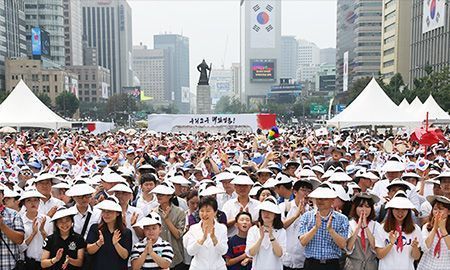
President Park Geun-hye participates in a ceremony at Gwanghwamun Square in central Seoul, Saturday, to mark the 70th anniversary of Korea’s liberation from Japan’s 1910-45 colonial rule. / Yonhap
By Kang Seung-woo
Japanese Prime Minister Shinzo Abe’s comments on the anniversary of the end of World War II and President Park Geun-hye’s soft criticism of the Japanese leader are raising the prospect of a thaw in frosty ties between the two nations.
Abe stopped short of making his own apology in the statement marking the end of World War II on Friday and the next day President Park Geun-hye refrained from harsh criticism of what the Japanese leader said and left much else unsaid.
Analysts took Park’s relatively prudent reaction as a sign that she is seeking to mend ties with Tokyo.
But they said history issues would probably remain a major hindrance to rapprochement unless Japan really took “sincere action” to address Korea’s demands.
“It is hard to deny that Prime Minister Abe Shinzo’s statement marking the 70th anniversary of the end of World War II did not quite live up to our expectations,” Park said during her Liberation Day speech on Saturday.
“But Korea takes note that Abe’s pledge that the previous Cabinets’ position will remain unshakable into the future.”
The foreign ministry also said in the national interest it would adopt a two-track policy in dealing with Japan ― separating historical issues from security challenges posed by North Korea.
Lee Won-deog, an international politics professor at Kookmin University, described Park’s remarks as “future oriented.”
“Her speech is mindful that she needs to normalize the strained relations with Japan ― especially a trilateral summit with China and Japan,” Lee said.
The last three-way summit was held in May 2012 and President Park proposed to resume the meeting in November.
In March, the three countries’ foreign ministers talked about the issue during their meeting in Seoul. Should the three-way meeting be fixed, Korea will host the talks because Seoul was supposed to hold them in 2013.
“While Northeast Asia is a rapidly changing the geopolitical landscape and each nation is bustling to find strategies that will maximize their national interests, Park is also seeking to take the initiative by improving ties with Japan,” Lee said.
Kim Yeoul-soo, an international relations professor at Sungshin Women’s University, said the Park government was now dealing with the issue strategically.
“Although public sentiment toward the Abe statement may remain negative, the government is making a strategic approach in order to mend fences with Japan,” Kim said.
He also said that the Korean government seemed to have set its sights on holding the trilateral summit.
“Park and Abe may travel to China next month, so there might be discussion about the meeting between the three nations,” he said.
Kim added that the three-way summit could pave the way for the first bilateral meeting between Park and Abe.
Despite the promising outlook for the Korea-Japan relationship, there is a sticking point to overcome: the sexual enslavement of Korean women.
In the statement, Abe failed to refer directly to the victims, saying only that “the dignity and honor of many women were severely injured during wars in the 20th century.”
“The sex slave issue needs to be settled at the appropriate level and both sides may face difficulties in negotiations to solve it,” Lee said.
“However, aside from the issue, the government needs to strive to get the relationship back on track because the U.S. and Japan have beefed up their alliance and Japan and China are showing signs of advancing their ties.
“We should not confine the relations with Japan to historical issues.”