'GI babies' inspire US family to pursue philanthropy

Molly Holt speaks during an interview with The Korea Times at the Holt Ilsan Town Home in Gyeonggi Province on July 18. / Korea Times file
By Kang Hyun-kyung
ILSAN, Gyeonggi Province — There are no official data that can provide the exact number of illegitimate children born between American soldiers and Korean women during and after the Korean War.
However, according to several documents, the number of these post-war interracial children who were left behind by their parents without sufficient care and protection was large enough to draw the attention of concerned people outside the country.
The desperate plight of these so-called “GI babies” motivated the farmer-turned-timber businessman Harry Holt (1904-1964) to pursue a life of philanthropy in his later years. He adopted eight Korean War orphans, seven of whom were Amerasians, in 1955 and established the orphanage and adoption agency Holt Children’s Services in Seoul the next year.
“Amerasians had the most urgent needs, especially the black ones,” Molly Holt said during an interview with The Korea Times on July 18 at the Holt Ilsan Town Home, a shelter for disabled children and adults that her father, Harry Holt, built in Gyeonggi Province in 1961.
Molly, 80, the third child of the late Holt and his wife Bertha, has been involved in her father’s humanitarian work starting in the late 1950s after graduating from nursing school.
Her father decided to adopt GI children in 1955, a year after he and Bertha watched two touching documentaries made by Bob Pierce, president of the humanitarian relief group World Vision, at a high school in Eugene, Oregon in the fall of 1954.
“Dead Man on Furlough” and “Other Sheep” dealt with Korean War orphans and widows and the preponderant prejudices against GI babies.
GI babies were abused, neglected and treated as social outcasts. Korea back then was much more homogeneous and influenced by Confucianism than it is today. Foreign-born people, including naturalized citizens, now account for 3.5 percent of the entire Korean population.
GI children were regarded as the first wave of mixed-race population in modern Korean history. The tone of a news article published on September 21, 1952 reflects the Korean public’s perception of GI babies at that time. “Mixed-race children have emerged as a major social problem, as their number has increased since the war,” the article read.
“Black families in America wanted to adopt black children in Korea,” Molly said. “They needed to be adopted. I saw them on the streets, and people called them ‘twigi,’ (which means interracial children). They were hit and beaten by other children.”
Elizabeth Kim, an interracial Korean War orphan, described her traumatic childhood as a GI child in great detail in her 2000 memoir, “Ten Thousand Sorrows: The Extraordinary Journey of a Korean War Orphan.” Elizabeth Kim is a pen name.
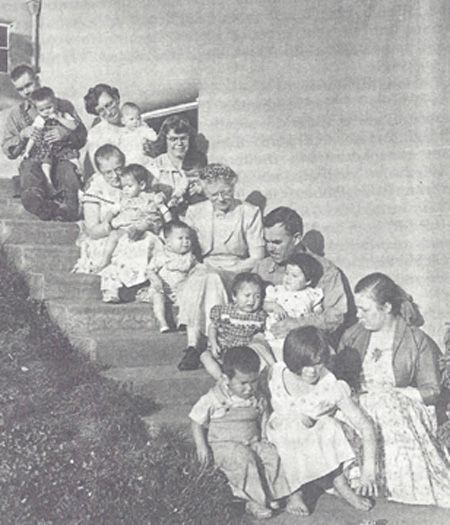
This photo shows the entire Holt family on the back stairs of their home in Creswell, Oregon. / Courtesy of Phil Welest
Kim’s father walked out on her mother when she was still pregnant. Her mother was forced to go back home to seek assistance from her family, who treated both mother and daughter badly. They felt her having an interracial child brought shame to the family.
After giving birth to Elizabeth, her mother worked in the rice fields. On the way home from the rice fields, Elizabeth and her mother would be pelted with stones by their neighbors. Eventually, her mother became a victim of honor killing when she refused for Elizabeth to be sold as a slave to some relatives. Elizabeth’s grandfather and uncles hanged her mother in front of her.
Elizabeth was very young when her mother was killed. She said she didn’t remember how old she was at that time. Elizabeth was dumped in an orphanage in Seoul, where she was later adopted by an American couple. But her ordeals, including discrimination, continued in the United States.
Pierce, who helped orphans in Korea after the war and showed the two Korean War documentaries to Oregon residents in 1954, recalled that Korea was racist after the war.
“The Koreans were very race conscious,” he was quoted in the book, “The Seed from the East” written by Bertha Holt.
“Mixed-race children will never be accepted into Korean society. Even the youngsters themselves are conscious of the difference. At a very early age they seem to sense that something is wrong.”
Until the 1990s, there were no protective policy measures for these interracial children in Korea. No organization or advocacy group represented their interests or tried to pressure policymakers to take affirmative action for the minorities, resulting in a policy vacuum.
Prejudices and biases against mixed-race people were preponderant in the society, including in schools and workplaces; thus, they found it difficult to complete formal education and get decent jobs. Eventually, they ended up in poverty.
It was in the 2000s when policymakers began to identify ways in which the government can help integrate ethnic minorities into mainstream society.
An influx of migrant workers and immigrant women who married Korean men starting in the 1990s has resulted in hundreds of thousands of interracial children. Some of these children were in elementary school at that time, but the school curriculum didn’t reflect the demographic change until the 1990s and the public awareness of ethnic minorities was still very low. The Korean government has since taken measures to address these issues.
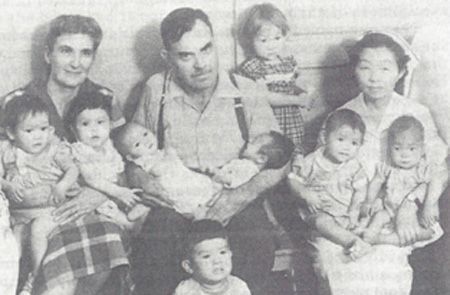
Harry Holt, center, with his adopted babies and aid workers
Purpose-driven life
Pierce showed the documentaries to fellow Americans to gain their support and encourage them to volunteer to help the war orphans in Korea. As Pierce pleaded for their help, he also explained the potential risks of working in Korea, including Asiatic diseases, long working hours and communist threats in the post-war reconstruction in South Korea.
Molly said the movies touched her parents and motivated her father to dedicate the rest of his life to helping war orphans in Korea.
“My father was ready to do that when he saw the movies,” she said. “He built a big house in Creswell, Oregon and realized that he could have eight more children.”
According to her, the entire Holt family became Christians after her father had a severe heart attack when he was 45.
“We wanted to do what Jesus wanted us to do, and that happened to us.”
Harry Holt visited Korea in 1955 to take the necessary steps to adopt eight children. During his months-long stay in the war-torn country, he visited several orphanages in Seoul and the southern city of Daegu and saw the miserable conditions the babies endured. They were neglected and malnourished and many were sick with epidemic diseases.
The trip to Korea made Holt realize that adopting eight children was not enough to make a difference for the GI children. After adopting the eight children, he returned to Korea a year later and founded Holt Children’s Services in 1956, which would find qualified adoptive parents in the United States for abandoned babies.
The Holt family was featured in several American media outlets after their adoption of Korean War orphans. They received many letters and phone calls, mostly from black American families, about how to adopt GI babies.
From 1956 to 1964, before he died of heart disease, Holt traveled back and forth between Creswell, where he managed a timber business, and Seoul, where he facilitated the adoption of the orphans.
His family performed much of the humanitarian work of the organization, taking care of the abandoned babies at the orphanage in Seoul and screening and finding adoptive parents.
Holt’s health worsened as time went by. His wife Bertha also traveled back and forth between the two cities with their eight adopted children. She knew that her husband would not live much longer because his heart disease was worsening, and she wanted their young children to see him as much as possible while he was still alive so that they could remember him.
The Holt couple’s great partnership helped their humanitarian work go smoothly, according to their daughter Molly. She said her father was a determined man who had the support of her mother.
“My mother was the organizer who put the pieces together. My father got a lot of things started but was unable to finish them. He said he started so many things that he didn’t finish and someday he would hire someone who will,” she said.
“My father was a genius. Although he didn’t have much of a formal education, he read lots of books. He invented many machines (for use in his timber business).”
Harry Holt sold his beach land in Oregon so that he can purchase land in Korea on which he could build Holt Ilsan Town Home for the disabled children who had failed to find adoptive parents.
Since the Korean War, approximately 150,000 Korean babies have been adopted by people from overseas through these adoption agencies. The Holt orphanage has played a central role in helping abandoned babies find adoptive parents.
Overseas adoption has decreased since the mid-1980s following media reports about some adopted children having traumatic childhoods because of their abusive parents. The Korean government has since strengthened the requirements for overseas adoption.
Under the law, adoption agencies must prioritize domestic adoption and must prove that they tried hard to find adoptive parents at home for the first six months after receiving the abandoned babies before finding adoptive parents from overseas.
The strengthened rules for overseas adoption resulted in an increase of domestic adoption, which finally surpassed overseas adoption in 2007.
Some social workers, however, are critical of the six-month rule, claiming the rule makes it difficult for the babies to adapt to their new family environment.
According to them, it takes approximately two years from when they first receive the babies from the birth parents before they are able to send the babies to the adoptive parents overseas.
During those two years, foster mothers take care of the babies. Thus, by the time the babies are handed over to the adoptive parents, they have already built a relationship with the foster mothers.