Exodus to Jeju increasing
By Lee Kyung-min
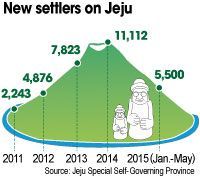
More people are moving to Jeju Island, fed up with the stresses of city life.
According to a Statistics Korea study, as of May this year, the number of people that moved to the southern resort island stood at 5,500.
The number of new arrivals on Jeju has been rising steeply since 2011, with the total tallied at 2,243 in 2011; 4,876 in 2012; 7,823 in 2013; 11,112 in 2014.
Wage earners with families, in their 30s and 40s, account for more than half the migration, with the number tallied at 3,569 households with 7,439 members in 2014.
Relocations of whole families to Jeju account for more than 20 percent, the second-largest such movement after that to Gyeonggi at 30 percent and North Chungcheong Province at 12 percent.
Most who relocate to Jeju open small businesses targeting tourists, including coffee shops, restaurants, and guesthouses.
Often their children attend international schools there, including North London Collegiate School Jeju, Branksome Hall Asia and the Korea International School Jeju campus, all in Seoguipo.
Parents are reportedly attracted to the schools’ curricula that are more in line with international standards, unlike Korean schools that regard admission to prestigious universities as the sole purpose of education before college.
The migration was also prompted by a slew of abuses in daycare centers across the country a few months ago.
Instructors hitting toddlers were captured in detail on surveillance cameras. Many of the suspects were apprehended following the abuse.
For mothers with toddlers who cannot afford to move to foreign countries, moving to Jeju Island is the next best thing, according to opinions expressed on online community forums.
More mothers are seeking to raise children safely there.
“After moving to Jeju, taking care of children will be the top priority for many the like-minded mothers,” a mother wrote on a community website.