Ex-green growth chief blames gov't for lowering carbon emission goals
By Kim Se-jeong
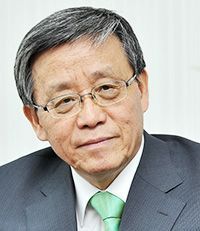
Young Soo-gil
Young Soo-gil, who played a crucial role in setting up Korea’s carbon emission goals in 2009, criticized the Park Geun-hye administration Sunday for attempting to lower emission targets for the benefit of businesses.
“All four proposals being discussed undermine Korea’s commitment to reducing greenhouse gas emissions made before the international community,” said Young in a statement.
Young, who headed the Presidential Committee on Green Growth under the Lee Myung-bak government, is currently heading the Korean office of the Sustainable Development Solutions Network (SDSN), launched by U.N. Secretary-General Ban Ki-moon in 2012. The green growth panel is now under the Office of the Prime Minister.
“The SDSN would like to suggest that the government recalculate the numbers using accurate data and open debate to come up with a new reduction target,” Young said.
In 2009, the Lee government vowed that by 2020, Korea would reduce its greenhouse gas emissions by 30 percent from the business as usual (BAU) level in 2005, with anticipated emission amounts at 543 million tons.
However, the Park administration presented four proposals on June 10 ― all of which are lower than the emission goals announced in 2009.
The government will choose one of the proposals next week and submit it to the U.N. conference on climate change. If agreed in December, that will become a binding target for Korea for the next 15 years.
The four proposals include a 14.7-percent reduction from the BAU level in 2005 to 726 million tons of emissions; a 19.2-percent reduction to 688 million tons; a 25.7-percent reduction to 632 million tons; and a 31.3-percent reduction to 585 million tons. The problem is that all the numbers are higher than the target set for 2020.
The government’s move is drawing harsh criticism in and outside Korea
Yvo de Boer, the director general of the Global Green Growth Institute said, “The purpose of a global accord on climate change is to reduce emissions, not increase them. Korea really needs to join the international community to curb global warming and be much more ambitious and serious about reducing emissions,” he said.
De Boer was the executive secretary of the United Nations Framework Convention on Climate Change between 2006 and 2010.