'Park, Obama should coordinate on NK threat'
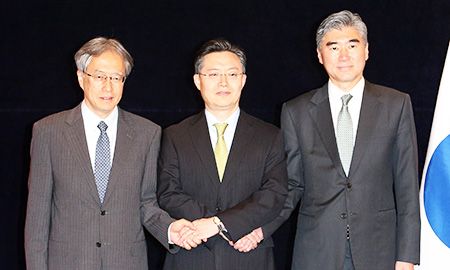
South Korea’s top nuclear envoy Hwang Joon-gook, center, holds hands with his Japanese and American counterparts Junichi Ihara, left, and Sung Kim, prior to engaging in talks at the Lotte Hotel in Seoul, Wednesday. / Yonhap
By Kang Seung-woo
President Park Geun-hye and her U.S. counterpart Barack Obama need to put the ever-worsening North Korean nuclear issue on top of their June 16 summit agenda, diplomatic experts said Wednesday.
“Although there are no urgent issues between South Korea and the United States, the two heads of state need to focus on Pyongyang’s nuclear weapons program,” said Park Won-gon, an international relations professor at Handong Global University.
“While the North has increased its nuclear threats, the South and the U.S. have yet to come up with any measures to contain the issue. There should be a breakthrough in their efforts to denuclearize the reclusive country.”
Recently, the Kim Jong-un regime claimed that it has already made nuclear warheads small enough to fit on a missile — a key step toward building nuclear missiles — and it also test-fired a submarine-launched ballistic missile (SLBM).
President Park has entered her third year in office and there are only 18 months remaining of President Obama’s tenure.
“Taking into account their respective terms, it is time to propose an effective measure to prevent the issue from aggravating,” Park said.
The U.S. government continues to stick to its “strategic patience” approach, a policy that means no engagement with the reclusive state, and the Park administration continues to pursue its trust-building process on the Korean Peninsula, with both of them failing to pay dividends.
“Euphemistically, we call it strategic patience, but to be frank, the U.S. seemingly does nothing to resolve the issue,” Park said.
Van Jackson, a visiting fellow at the Center for a New American Security, echoed Park, citing that the North is gradually modernizing its military such as a drone fleet, anti-ship cruise missiles, cyber units and research on sea-launched ballistic missiles.
“Strategic patience has proven a failed policy because it does nothing to address North Korea’s worsening nuclear and missile programs. Nothing as far as I can tell,” he said.
As for Park’s initiative regarding the issue, the North has criticized it, calling it preparation for unification by absorption.
However, Kim Yeoul-soo, a professor of international political science at Sungshin Women’s University, said it will not be easy for the two countries to make any decisive action related to the North’s nuclear issue.
“In six months, the U.S. will be in full election mode and every issue will be clouded by the presidential election,” Kim said.
“The North Korea issue can be out of sight in the U.S.”
In addition, amid growing threats from Pyongyang, the U.S. may opt to impose its own sanctions against the North, or seek support for them within the United Nations, hinting that the situation on the Korean Peninsula is likely to get worse, Kim added.
In the wake of the North’s SLBM launch, U.S. officials, including Secretary of State John Kerry, have mentioned a possible deployment of the Terminal High Altitude Area Defense (THAAD) against the new threat. It raises speculation that Park and Obama may discuss the thorny issue that also puts the Seoul-Beijing ties on the line.
However, analysts disagree about this possibility.
”There has been no official negotiation on the issue between the two sides, so it will not be an agenda for the summit,” said Professor Kim Hyun-wook of the Korea National Diplomatic Academy.
Kim Youl-soo also said that it is a ministry-level issue and not something that the state leaders need to discuss.