Founding President's independence activities chronicled in English

The final page of a journal written in English by late former President Syngman Rhee. / Yonhap
By Do Je-hae
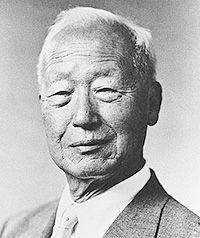
Syngman Rhee
For a Korean born in the late 19th century, the nation's first president, Syngman Rhee (1875-1965), had a unique relationship with the English language.
Educated in top schools in the U.S., he was the first Korean to give public speeches in English.
Rhee kept a diary in English during his early years, which will be published for the first time in July, according to a Seoul-based institute Monday.
The founding President of the Republic of Korea led the nation through the 1950-53 Korean War. He was a pro-independence activist against Japanese rule before he assumed the nation’s top office in 1948.
A collection of his diaries chronicling his diplomatic efforts to liberate Korea will be published in the original English version as well as a Korean translation.
The Syngman Rhee Institute of Yonsei University will publish the collections, written in English by Rhee from 1904 through 1934.
To mark the publication, the institute will hold an international conference on Rhee on July 23-24 at the National Museum of Korean Contemporary History in central Seoul.
The institute has been translating the diaries into Korean since 2012.
The diary covers the period of his life in the United States which began in 1904. He obtained a bachelor of arts from George Washington University in 1907, then a master of arts from Harvard University in 1910 and a Ph.D. from Princeton University the same year.
The diaries contain the details of Rhee's diplomatic activities, such as his arguments with the U.S. Department of State representatives on the timing of Korea's liberation.
In 1919, Rhee petitioned to U.S. President Woodrow Wilson and the Peace Conference in Paris, underlining the illegality of the Japanese occupation (1910-1945).
“These documents reflect the times,” Rye Seok-chun, head of the institute, told Yonhap. “The extensive diaries were translated into Korean by experts in Rhee studies.”
Rhee led the provisional government from 1919 through 1925. Critics of the provisional government continue to doubt its legitimacy, as colonial powers of the time did not recognize it as a proper administrative entity. The debate over its legal status and achievements continues among Korean historians.
“I was genuinely surprised to discover that Rhee's diplomatic efforts and activities during his days in exile in the United States to win recognition for the provisional government had been far broader and more sophisticated than were generally known,” wrote Lew Young-ick, a renowned scholar on Rhee, in the preface of his 2014 English-language book “The Making of the First Korean President.”