Expats voice personal stories through Korean speech contest
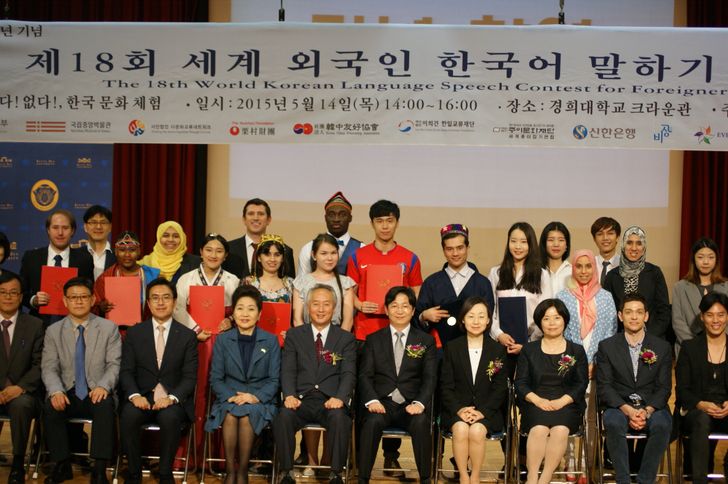
The 18th World Korean Speech Contest in Kyung Hee University, was co-hosted by the school's Institute of International Education and Yonhap News Agency. / Courtesy of Kyung Hee University
By Lee Ji-hye
The rising popularity of the Korean language can be observed in the proficiency among participants in a Korean speech contest held Thursday.
At the 18th World Korean Speech Contest co-hosted by Kyunghee University and the Yonhap News Agency, 16 finalists from 14 countries presented three-minute speeches in fluent Korean, a language that was neither their mother tongue nor even a second language for some.
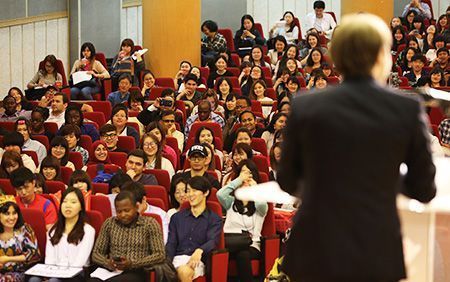
/ Yonhap
According to the organizers of the contest, more than 1,240 people applied in the initial stages of the contest, with the field whittled down before and during the interview stages and the final rounds. Approximately 16 are selected each year to deliver a short Korean speech at the university. The content and proficiency of the finalists has improved markedly in recent years.
“We started off this contest in 1998 with hopes to promote the Korean language and culture among people visiting this country, but there is a different message that I wish to deliver through this competition,” Cho Hyun-yong, the dean of the Institute of International Education of Kyung Hee University told the Korea Times.
“The contest has a new meaning now, and that is to deliver a message to the Korean audience that a lot of foreigners, too, are now fluent speakers of the Korean language. Koreans need to realize that,” Cho said, adding that with fluency spreading among non-Koreans worldwide, it has become crucial for Koreans to show more interest about culture all over the world and share stories that may be delivered with the Korean language.

Mongolian student Uyanga Ulziikhutag, who won first place, delivers her speech.
According to the Modern Language Association, university language class enrollment in the United States experienced a near 45 percent increase in the number of students studying Korean from 2009 to 2013. During the same period, enrollment in Spanish, French and German fell by 6.7 percent.
Analysts say that Korean cultural content, such as dramas and K-pop, is behind the surge in people learning the Korean language over the last several years.
Speech topics ranged widely, including personal encounters with Korea’s delivery service, adjusting to a new chapter in life and political viewpoints on the Dokdo Islets.
“It’s amazing what different food can be delivered in Korea _ you can eat whenever you want, and wherever you want here in Seoul,” said Uyanga Ulziikhutag, a student from Mongolia who took home the grand prize for the contest.
"Being able to order food 24 hours a day is something I cannot imagine back at home. It's definitely something that I want to compliment the delivery people for being diligent," she said, adding that the delivery culture in Korea adds to an experience that is already somewhat "like a fairytale."
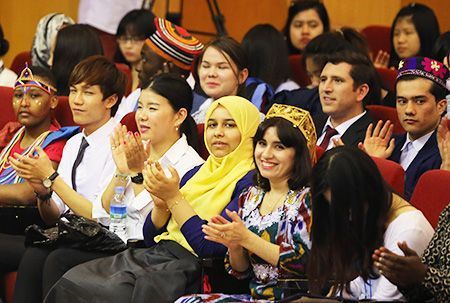
Participants of the speech contest applaud fellow speakers.
Another student introduced her newfound interest in the southeastern islets of Dokdo, delivering a poetic speech based on her visit there for the first time.
Jane Wanjiru Mbagara from Kenya, who tied for second-place, said during her speech, "I was deeply moved by all the Koreans that had so much passion towards this island, as if they were looking after a child, or speaking to an adored elder or a loved one."
Mbagara said that her experience moved her to write a poem about Dokdo, which she recited at the contest.
"At the far east proudly you stand, two empty rocks, yet so rich. Home to many birds, home to abundant resources, with the birds flying around, and the welcoming cool breeze," she said as she read her poem, receiving lighthearted laughter and applause from the audience.
Choi Sang-jin, the leading judge of the contest’s evaluating committee, said such a rapid improvement in the contestants’ fluency has never been seen before.
“These contestants are not just special to the contest alone, but are very precious members in our society," Choi said, adding that the speakers seemed to think more deeply and critically about the Korean language and society.
"We have so much to learn from these people, who went out of their way to learn Korean and embrace our culture."
.jpg?w=728)
Friends of participants show support for the contestants.
Who is Uyanga Ulziikhutag?
Q: In your speech, you mentioned that you learned ballet for a long time. What made you want to study economics in Korea?
A: It's a question that I get a lot, "Why didn't you choose arts instead?" In fact, it was quite simple for me. I wanted to be a person who makes a lot of money, and I wanted to be a smart person. Our family back at home faced many financial difficulties, so I had to give up my dreams of ballet to support my family. It was a difficult choice, but I am sticking to my decision despite the hardships along the way, and I plan to continue to pursue my ambitions of studying here in Korea.
Q: You came to Korea at a young age. Didn't your parents oppose that at first?
A: They did. When I came here at age 17, my parents and relatives opposed the idea of our family being scattered across the world. My mother was in Spain at that time as well. I told them that I would study in Korea and even go to college here, so I think they trusted my plans. I remember participating in a Korean singing contest held in Mongolia to win a six-month language course scholarship to Korea in order to persuade them to let me go.
Q: You discuss dieting a lot in your speech along with the delivery food culture. What's it like in Mongolia?
A: There are some people back in Mongolia that do go on diets, but it's not as serious as it is in Korea. Many women in Mongolia are rather muscular and athletic, so they do not worry much about getting fat. But here in Korea, girls aim for an extremely skinny goal when they go on diets, because according to their standards, it is considered beautiful. I know a Korean friend who doesn't need to go on a diet, but won't stop trying to lose weight. I thought eating less than working out to lose weight was an interesting thing that Korean girls have in common.
Q: What do you wish to achieve through this contest?
A: I want to let the Korean people know how much foreigners are interested in Korea and its culture. I'm happy to have this platform to deliver my passion about Korea. I want to especially target the Koreans that have a rather negative viewpoint towards foreigners in Korea, because they tend to think that foreigners are simply here in Seoul to make money, and nothing else. However, I can say with confidence that one of my smartest decisions was to come and study in Korea, and that I think of Korea with a grateful heart. I will continue studying the Korean language and culture even after this contest.