Assembly urged to pass pension bill
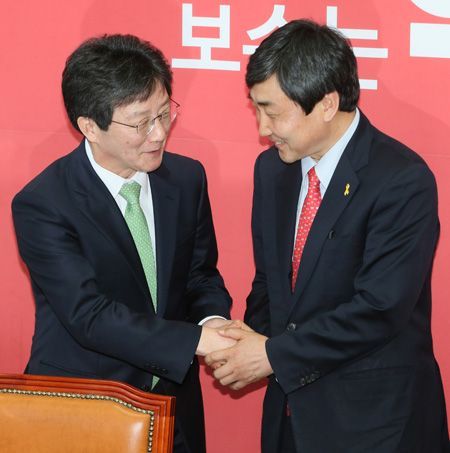
Saenuri Party floor leader Rep. Yoo Seung-min, left, shakes hands with Rep. Lee Jong-kul, the new floor leader of New Politics Alliance for Democracy, during a meeting at the National Assembly in Yeouido, Seoul, Sunday. / Yonhap
By Do Je-hae
The opposition New Politics Alliance for Democracy (NPAD) floor leader Rep. Lee Jong-kul met his Saenuri Party counterpart Rep. Yoo Seung-min Sunday and agreed to act swiftly on several economic bills pending parliamentary approval.
They decided to hold plenary sessions on May 12 to deal with bills related to income tax and local finance. Another session will take place on May 28.
It was the first such meeting since Lee took office on May 7.
The two parties also agreed to honor the agreement reached on the civil servants pension bill among party leaders on May 6 and continue talks on the matter.
The bipartisan agreement came after Cheong Wa Dae called on the National Assembly Sunday to work together for the passage of the pension bill and bills related to people’s livelihood.
It blamed the Assembly for failing to approve the bills last week.
The pension revision has roiled the National Assembly, which will begin a month-long extraordinary session today. Last-minute disagreements on the bill delayed a full session at the legislature last week, cancelling voting on a series of urgent economy-related bills.
“The passage of the civil servants' pension bill is a top priority,” said senior presidential press secretary Kim Sung-woo. “Parliamentary approval of the bill this month is crucial.”
President Park Geun-hye has highlighted overhaul of the debt-ridden public employee pension system as a key task of her presidency. But the political impasse has been a major impediment.
Passage of the bill has been on hold since rival parties failed to agree on conditions for possible approval. Lately, transforming the National Pension Fund (NPF) as part of the pension deal has emerged as a roadblock.
The parties have conflicting positions on revising the NPF, particularly over increasing the income replacement ratio.
The main opposition wants the overall national pension plan to be increased to cover 50 percent of pre-retirement income from the previous 40 percent. Cheong Wa Dae and the ruling party are apprehensive about this proposal because of pensioners' tax burdens.
The ruling Saenuri Party's last-minute rejection of the proposal resulted in a parliamentary deadlock on May 6.
Kim repeated Park’s opposition to linking the national pension to the civil service pension.
"Those are separate issues," Kim said.
"Increasing the income replacement rate and the insurance rate cannot be decided upon parties' own interests. “We need to first hear people's thoughts on how the national pension should be reformed.”
Kim criticized the opposition’s proposal, explaining that raising the replacement rate to 50 percent would require an additional 1,702 trillion won in taxes over the next 65 years.
“An increase of even one percentage point in the income replacement rate may lead to a disastrous burden on future generations,” Kim added.
The NPAD slammed Cheong Wa Dae for meddling in parliamentary affairs.
"The fault lies in Cheong Wa Dae for not passing the bill," NPAD spokesman Kim Young-rok said Sunday. "The Park administration is continuing to give directions to the Assembly. This is an overstepping of parliamentary authority.”