Assembly fails to vote on pension bill
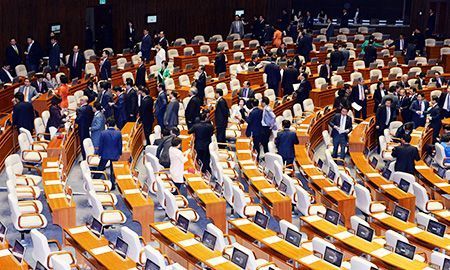
The ruling Saenuri Party members leave the National Assembly after the rival parties failed to pass a pension reform bill for civil servants during a plenary session, Wednesday. / Yonhap
By Do Je-hae
The National Assembly failed to pass a pension reform bill in the last day of a plenary session Wednesday due to a continuing standstill on conflicting details.
Rival parties were stuck in deadlock over the income replacement ratio for the National Pension Fund (NPF).
The floor leaders of the ruling Saenuri Party and the New Politics Alliance for Democracy (NPAD) called a second emergency meeting at 8:00 p.m. to negotiate the main opposition's demand to increase payouts to pensioners who have subscribed to the NPF from the present 40 to 50 percent. But both sides failed to reach a consensus.
"We cannot accommodate the NPAD's position," Saenuri Party Chairman Kim Moo-sung told reporters.
The Saenuri Party has been against stipulating the figure 50 percent, stating that any specific statistic should not be written in until further discussions among lawmakers and experts.
The income-replacement rate is a figure derived from a retiree's average income. Korea's income replacement rate, if raised to 50 percent, is below the 61 percent average in OECD countries.
The parties were expected to put the bill to a vote in the plenary session, which was to resume at 7:00 p.m.
"At this point, we are uncertain about a deadline for passing the bill," Kim said.
National Assembly Speaker Rep. Chung Ui-hwa refused to resume the session and Saenuri lawmakers left the main hall around 9:00 p.m.
"We will have further discussions with the new NPAD floor leader," Saenuri Party floor leader Rep. Yoo Seung-min said.
The main opposition will elect a new floor leader today to replace Rep. Woo Yoon-geun.
The NPAD has asked for the opening of an extraordinary session on May 11.
Last-minute disagreements on the pension bill delayed a full session at the legislature, cancelling voting on a series of urgent economy-related bills.
"We will boycott other bills unless the 50 percent figure is included in revised texts of the bill," said NPAD spokeswoman Seo Young-kyo.
The situation is an about-face from earlier proceedings of the final day of the plenary session when it looked as if the bill's passage was on course.
In an emergency meeting at 3:00 p.m., Yoo and Woo had tentatively agreed to add the 50 percent income replacement rate to the annex of the rules of the National Assembly.
The main opposition New Politics Alliance for Democracy (NPAD) has called for raising the income replacement ratio of national pension to 50 percent and injecting 20 percent of a fiscal cutback from the civil servant pension fund reform into public funds.
Critics slammed the parties’ decision to link civil service pensions with the NPF.
President Park Geun-hye was in line with such criticism. She denounced the Assembly, saying, “Changing the national pension scheme, subscribed to by more than 20 million people, is a matter that will put a heavy burden on the public.”
According to the new law, a civil servant whose monthly salary is three million won ($2,800) will have to pay a 270,000 won pension premium per month, up from the current 210,000 won.
The pension they would receive after retirement will also fall to 1.53 million won from 1.71 million won.