Hwang slams Abe for not facing up to shameful past
By Jung Min-ho
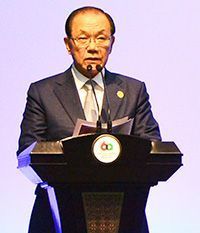
Korea's Deputy Prime Minister Hwang Woo-yea delievers a speech at the Asia-Africa Conference in Jakarta, Wednesday. /Courtesy of Ministry of Education
JAKARTA ― Deputy Prime Minister Hwang Woo-yea said Wednesday that Japan’s reluctance to face up to its wartime wrongdoings is preventing many Asian countries from moving forward.
In his statement aimed at Japan’s Prime Minister Shinzo Abe, Hwang, who is attending the Asia-Africa Conference on behalf of President Park Geun-hye, criticized Abe for his repeated attempts to distort history.
“Unfortunately, historical issues in Northeast Asia have yet to be overcome, and we instead are witnessing a rise in historical revisionism,” he said. “This has caused mistrust and tension, and has deterred reconciliation and cooperation between countries in the region.”
To become a responsible member of the regional community, Hwang said, Japan “must face up to its past.”
“With this being the basis, there must be sincere remorse and apology, as well as proper education for the next generation,” he added.
Hwang’s attacks on Japan’s stubbornly unrepentant attitude came after Abe’s speech, in which he expressed the nation’s “deep remorse” but offered no apologies to the Asian countries affected by Japan’s colonial aggression before and during World War II.
Abe said Japan will refrain from acts or threats of aggression against the territorial integrity or political independence of any country. He noted, “Japan, with feelings of deep remorse over the past, made a pledge to remain a nation always adhering to those very principles, no matter what the circumstances.”
His expression of “remorse” apparently isn’t enough for Korea, a country that still has 53 living “comfort women,” who were coerced into sexual slavery by the imperial army soldiers of Japan during the war.
After Abe’s speech, the Korean government immediately released a statement, saying it deeply “regrets that Japan did not apologize” at the conference.
The Korean government added that it hopes proper historical awareness will be reflected at his upcoming speech at the U.S. Congress on April 29.
On Tuesday, a group of U.S. congressmen also called for Abe to issue an apology for his nation’s sexual enslavement of thousands of Asian women in wartime brothels when he addresses a joint session of Congress.
Rep. Mike Honda (D-CA), Rep. Steve Israel (D-NY), Rep. Bill Pascrell (D-NJ) and Rep. Charles Rangel (D-NY) made the request in their speeches at the House.
Abe is scheduled to give a speech at a joint meeting of the House and Senate during a visit to Washington next week for a summit with President Barack Obama. He will be the first Japanese Prime Minister in history to address the U.S. Congress.
“He has the opportunity to do right by these women,” Honda said. “He can make a full, unequivocal and formal apology on behalf of the Japanese government.”
Honda’s speech drew keen attention in particular as one surviving victim, Lee Yong-soo of Korea, 87, looked on from the public gallery. While explaining details of the suffering of the sex slave victims, Honda, a third generation Japanese American, told his colleagues that Lee was kidnapped in 1944 when she was 16 and forced to work as a sex slave in Taiwan. He added that Lee also suffered beatings, torture and disease.
Rep. Israel said that the Abe’s planned speech “must be honest” and address Imperial Japan’s wartime atrocities, stressing that ignoring such acts would be to “ensure a very troubling future.”