New prime minister an asset for President Park
By Do Je-hae
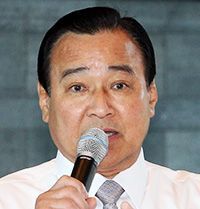
Lee Wan-koo Prime Minister
SEJONG ― Prime Minister Lee Wan-koo is turning out to be one of President Park Geun-hye’s biggest political assets.
Since taking office on Feb. 27, Lee has been an energetic messenger relaying Park’s main policy goals while stabilizing the Cabinet. Experts approached by The Korea Times this week were unanimous in picking Lee as one of the main reasons for Park’s upbeat approval rating last month.
The former South Chungcheong Province governor invited correspondents of the Prime Minister's Office to his residence at the nation’s administrative capital to share the preoccupations of his office.
The prime minister has been a staunch supporter of Park's anti-corruption drive to advance the nation’s public and business sectors. While underlining the true message of Park's anti-corruption campaign, he denied allegations that it targeted any particular political stalwarts of the Lee Myung-bak administration. “There are some skeptics who say that the investigations are aimed at allies of the former administration,” Lee said. “Such intentions are unthinkable. There are no partisan motives behind the anti-corruption drive.”
His first major engagement after taking office was to preside over a meeting with senior officials from law enforcement agencies to declare an “all-out war” on corruption.
Showing strong leadership in pushing the Cabinet through pressing issues, he has emerged as a possible presidential candidate for the ruling Saenuri Party. He represents the counties of Buyeo and Cheongyang as a member of the 19th National Assembly.
He spent a significant portion of the press conference fielding questions about his political future, particularly whether he will seek to run for the presidency. “Right now, I can only focus on my role as prime minister,” Lee said. “To be a prime minister means to serve the president and the people and lead the Cabinet. I consider this to be my last public office.”
He had been a vocal proponent of the creation of the administrative capital in Chungcheong region, widely viewed as a political and economic outcast in Korea. In 2009 while serving as South Chungcheong governor, he chose to quit in protest of the Lee Myung-bak administration’s attempt to scale down the Sejong City project. The creation of a separate administrative hub started during the Roh Moo-hyun years.
“After leaving the governorship, I stayed away from Sejong and never visited until I became prime minister,” Lee said. “This city was a source of great pain for me personally.”
He said that while today's Sejong is not what he had envisioned as South Chungcheong governor, he nonetheless is devoted to firmly establishing its status as the nation's administrative center.
"This is why I try to stay here and avoid going to Seoul as much as I can," Lee said. "If the prime minister makes Sejong a basis of his operation, I believe government officials will find it easier to bond with Sejong."
Many government complexes have moved into Sejong and its population is on the rise. But people still seem to find more faults with the new city rather than embrace the city’s long-term aspirations.
In particular, inter-city transportation and easier connections with the rest of the country remain unresolved.
"To build a city that is more readily accessible from other parts of the country, a new highway is being considered." Lee said.
Lee has also been vocal about other regional issues unlike his predecessor Chung Won-hong. During a meeting with North Jeolla Province Governor Song Ha-jin at the National Assembly Monday, Lee said that he will pay more attention to the development of the Saemangeum project in Song's province, the most underdeveloped region in the country. One of the world's largest landfill is undergoing transformation into a business and cultural hub in the nation's southern region.
The province's reclaimed tidal flats, Saemangeum, and the port city of Gunsan will jointly house an international business complex by 2020, devoted to boosting the automobile, shipbuilding and machinery industries, and tourism. Formerly, the Prime Minister's Office had been in charge of overseeing the developments, but ceased to do so in 2012.
The prime minister has received media attention for being an effective mediator between politicians and Cheong Wa Dae. “I try to meet party leaders as often as I can. I will be meeting with opposition leaders this week.”
Lee also underlined preparations for the 2018 PyeongChang Winter Olympic Games as a priority. “When I first assumed office, I called a meeting of relevant leaders within and outside the government to discuss the Olympic preparations,” Lee said.