Cabinet endorses anti-graft law
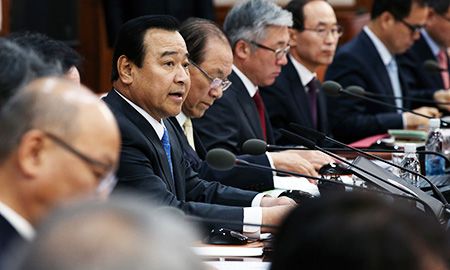
Prime Minister Lee Wan-koo speaks during a Cabinet meeting at the government complex in Seoul, Tuesday. The Cabinet passed a controversial anti-corruption bill and forwarded it to the presidential office, where President Park Geun-hye is expected to sign it into law. / Yonhap
By Yi Whan-woo
The Cabinet endorsed a new anti-graft law, Tuesday, amid lingering concerns over whether the legislation violates the constitutional rights of individuals.
At a weekly meeting presided by Prime Minister Lee Wan-koo in Seoul, the Cabinet handed the so-called Kim Young-ran law over to Cheong Wa Dae for presidential approval as stipulated by the Constitution.
President Park Geun-hye has pledged to fight against bureaucratic corruption. She is anticipated to approve the law passed by the National Assembly on March 3 in a bid to root out corruptive ties between officialdom and business.
The government is expected to publicly announce the new legislation by this Friday at the latest.
If it is confirmed, the law will take effect from September 2016 based on parliamentary approval.
Named after former Supreme Justice Kim Young-ran, the law has faced a series of setbacks over possible loopholes and other side effects.
The bill was originally aimed at rooting out bureaucratic corruption when Kim, a former Anti-Corruption and Civil Rights Commission (ACRC) chairwoman, proposed it in August 2012 during her ACRC chairwomanship.
Public officials and those at government-affiliated organizations, such as state-run enterprises, will face criminal charges if they receive money, valuables, treatment or services worth at least 1 million won ($904).
Punitive measures will be taken regardless of whether the money or goods were given in return for favors or not.
Concerns have risen that the law may be unconstitutional and infringe upon individual freedoms because journalists and private school teachers were also included in the targeted groups.
The legislation has also sparked controversy for scaling down the original bill that was initially set to target family members of the bureaucrats, including their distant relatives; it is now only applicable to the spouses of the targeted groups.
In their bipartisan agreement on March 3, the ruling Saenuri Party and main opposition New Politics Alliance for Democracy (NPAD) said the law, if necessary, should be revised during an 18-month grace period it takes effect on September 2016.
The ACRC said Tuesday it plans to announce subordinate ordinance in August in relation to the law.
The ACRC added such ordinance will require approval from the Cabinet and the President, but not the National Assembly, for it to take effect in September 2016.