Anger fuels young Muslims
Youth radicalization worries Korea
By Kang Hyun-kyung
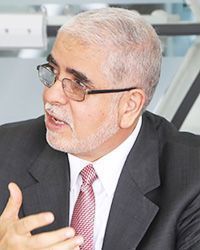
Libya’s former deputy prime minister Mustafa A.G. Abushagur speaks during a roundtable discussion about the democratic transition of his country at the Asan Institute for Public Policies on March 20. / Korea Times
The radicalization of young people has posed a fresh, common threat around the world after the militant group Islamic State’s (IS) brutal killings of civilians.
The wave of youth extremism concerns Korea as well after the National Intelligence Service’s confirmation that a missing teen identified by his surname Kim joined IS as a fighter and received military training in Syria.
Libya’s former deputy prime minister Mustafa A.G. Abushagur observed that the radicalization of youth has multiple roots.
During a roundtable discussion with experts at the Asan Institute for Public Studies in Seoul on March 20, he said that a sense of discrimination and some misleading Islamic preachers incited ethnic minorities, such as Muslims, to harbor hostility toward mainstream society.
“Some of their parents or grandparents immigrated to countries like Britain,” said Abushagur, now a member of the Libyan House of Representative. “I think that young Muslims in Europe feel a lot of discrimination in their society. They feel they are marginalized and many of them also feel they are treated differently in their workplace as well.”
Abushagur blamed some biased Islamic preachers for instilling young Muslims with extreme views toward the West.
“When I went to some mosques even in Tripoli, I felt that the teaching of Islam is flawed,” he said. “Those who teach them are narrow-minded. So those young people attending some mosques are trained to look at the world through dark glasses and believe that everyone outside them is an enemy they are supposed to fight.”
Last year about 20 British teenage girls fled the country to join IS, according to British Metropolitan Police Service Deputy Commissioner Helen Ball.
Ball told a BBC program that the girls were 20 or younger. “This is a growing problem and it’s one of real concerns,” she said.
Many of these young people, who join IS as fighters or brides for the jihadists, are from middle-class families, fueling speculation about what drove them to be radical.
The New York-based intelligence company Soufan Group estimates that at least 12,000 foreign fighters from 81 countries, including Korea, in Syria, are fighting with IS. Nearly a quarter of them are from Europe.
Abushagur said the Israeli-Palestine conflict also encouraged some youth to become extremists.
He said these young people felt that many Palestinians were dying and losing their homes because of the ongoing conflict, but the world was doing nothing and had turned a deaf ear to the humanitarian crisis.
He said the radicalization of young people in Europe was to some extent associated with the perception that the source of the Israeli-Palestinian conflict was European colonial rule.
The IS-led campaign portraying the West as a source of conflict effectively prompted young people to join the extremist group to fight against a common enemy.
After he attended the Korea-European Union seminar on the Middle East at Hotel Shilla in Seoul, Abushagur gave a briefing on Libya and Korea’s stake in the democratic transition of the North African country