Seventeen again at seventy's school
Courtesy of Pohang New Silver High School
Korea’s senior citizens relive their youths through uniforms and classes
By Lee Ji-hye
POHANG, North Gyeongsang Province ㅡ In the aging Korean society, youth is a luxury for many senior citizens. Now a coastal city in eastern Korea is providing a way for retirees to turn back time and relive their younger years by offering a campus life they never had the chance to experience back then.
Every Monday, Wednesday, and Friday, some 300 senior citizens above the age of 65 make their way to the city-sponsored Lifelong Education Institution as students at Pohang’s New Silver School.
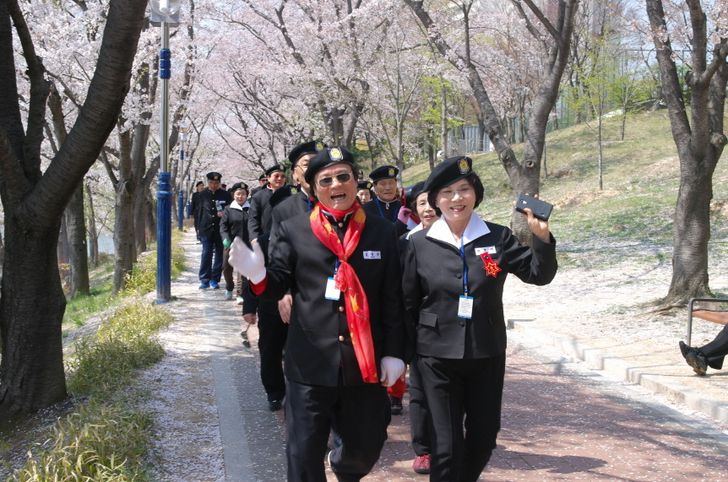
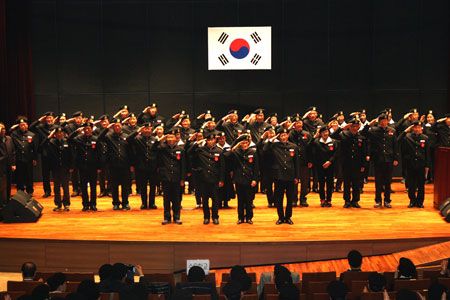
Wearing sailor suits, the students line up single-file to salute each other upon meeting in the auditorium.
They then execute a firm salute to their principal saying “gamsa,” or thanks, in Korean. The lines of cadets wearing fresh, ironed uniforms of black and white, and sporting neatly combed hair with a beret, contrasts with the deep wrinkles on their dark-spotted faces, their hunched backs and limping strides.
Courtesy of Pohang New Silver High School
“Shortly after the Korean War, many women had to look after babies and fix supper for the family and men had to go out to help make ends meet. There was simply no time for advanced education, let alone the experience of being on a school campus,” said Kim Jin-dong, the principal of the New Silver School. “Elderly citizens now get the opportunity to enjoy the youth they never actually had. It’s a chance that might not come again in their lives, literally.
“It’s the uniforms we love the best about the school,” he said. “A lot of the students say they feel a stronger sense of responsibility when they wear it ― they act much more disciplined than they normally would in public.”
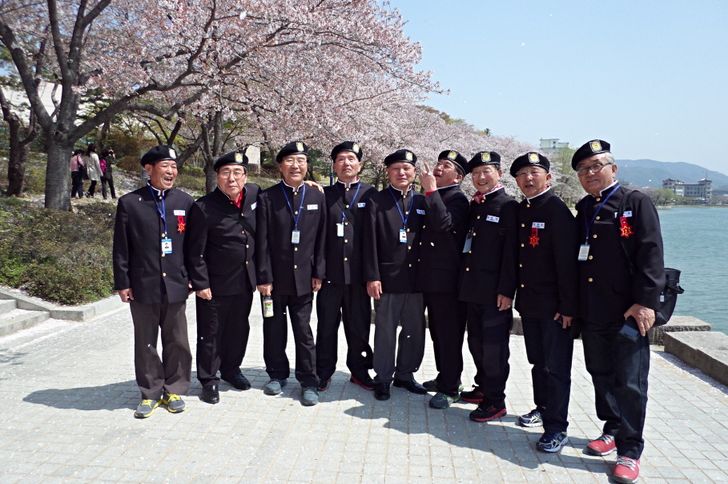
Resembling the images of how students dressed back in the 1960s and ‘70s, senior citizens say they feel privileged to wear the uniforms and relive the life they missed out on in the old days.
Courtesy of Pohang New Silver High School
“Being a cadet at this academy makes me feel alive and important,” said Jung Gyeong-ae, 74. “It’s a good place for senior citizens like me to come and wear this uniform, because I am a schoolgirl again ― young and with much potential.”
Jung, like others, has developed a wide circle of friends and acquaintances through the institution. After school they usually eat together or go for a stroll around the neighborhood.
Having met her best friend at the school, Jung walks around the campus hand-in-hand with Kim Gwang-woong, 67. Kim is instantly recognizable in a crowd as he always carries around a mini boom-box with old school music blasting through the speakers. Kim says the music gives him energy, and that his favorite time in the school schedule is the physical education class.
“I love dancing and stretching along to the songs with the energetic beats,” Kim said, waving a rainbow colored scarf at his fellow students as he danced around the classroom. “Being at this school, I can leave my worries aside for a while. Everything is fun, life is awesome and I feel like a teenager in love again.”
Courtesy of Pohang New Silver High School
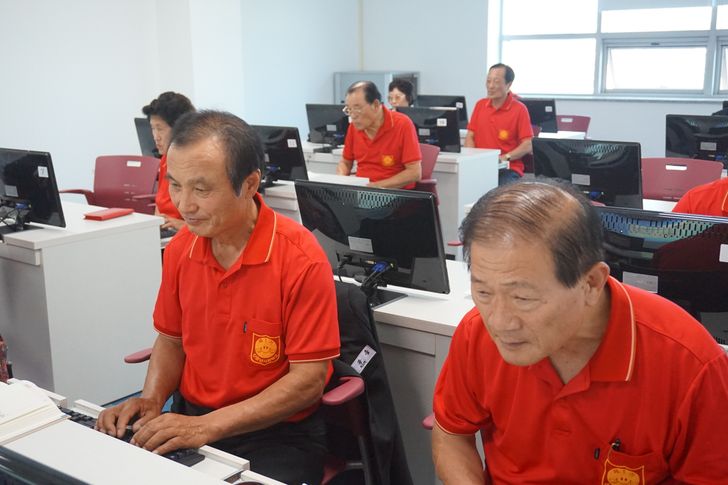
The New Silver School offers a wide range of majors, such as Korean literature, arts and crafts, computer science and physical education.
Jung Sang-hee, 72, chose to major in computer science in an attempt to alleviate the ever-growing generation gap and digital divide.
“I can’t understand half of the things kids these days say anymore, even if it’s in the same Korean language,” Jung said. “I’d feel much better if they were speaking in English, but we live in the same time and share the same space, but the things they do with their mobile phones and computers, I just can’t relate and it’s quite depressing.”
Students spent more than an hour in computer class mainly practicing typing their names on a keyboard.
“The thrice-weekly classes mostly revolve around getting used to the keyboards, and that usually takes more than a whole semester,” said Jeon Mi-seon, 48, the school’s computer class teacher.
“But there are some that do fairly well in the class and can make an e-mail account and sign up for online communities. But they usually forget what to do, and we have to start all over again by the next week,” Jeon said.
The most wired country in the world, South Korea is the world’s 15th-largest economy with a per capita income of about $26,000. However, senior citizens in Korea have the highest poverty rate among the elderly in the 34 advanced nations of the Organization for Economic Cooperation and Development (OECD), according to the Korea Labor Institute. A staggering 48.6 percent of the nation’s elderly are categorized as living below the poverty line. It also ranks first in terms of its suicide rate for senior citizens.
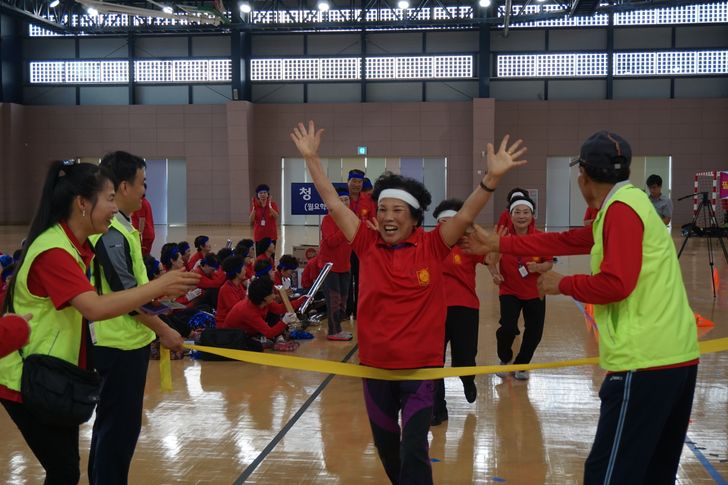
Courtesy of Pohang New Silver High School
Visiting the school at least once per semester, Lee Kang-deok, the mayor of Pohang City said, "They say an aging spirit is worse than an aging body, so my wish is that the students at the New Silver School spend a youthful four years and dream like they're young again, be ambitious, and regain the energy that they had back in those days."
Many students say this school is a platform for senior citizens to express their concerns regarding loneliness as they reflect on the past.
“When I was young, I could dance all night and sing very well,” said Lee Gi-seop, 78. “But now I can’t go for two minutes without coughing, or my voice cracking,” adding that he used to sing to his wife every night before she passed away.
“But what’s better is that I can write and paint about the agony that lives within me. I can express the sadness and the fear of death coming at me through the literature and arts classes here,” Lee said.
Hung in bold letters are the school’s numerous mottos such as: “So what if I’m old; life begins at 70,” and “Fortune comes to those that laugh like a child.”
Hwang Kwan-sik, 70, says that the senior students are reaping what they sowed.
“We deserve this more than anyone else in this nation,” Hwang said. “We want to be rewarded for founding this country. We fed our children, we took them to school and we sacrificed our youth for the backbone of the economy.
“But nowadays, nobody knows that. We are neglected, and people think it is a waste to invest in senior welfare when we are simply a couple of years away from our deathbed," he said.
“I didn’t know what youth was when I was young. How could I know? We didn't have time for that," Hwang said. "My true youth starts now, and that's what matters."