Attacker faces grave charges
Envoy to be discharged from hospital next week
By Jung Min-ho
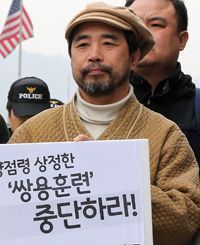
Kim Ki-jong
Kim Ki-jong, a xenophobic activist who attacked U.S. Ambassador to Korea Mark Lippert with a knife, Thursday, will face a charge of attempted murder, prosecutors said Friday.
The prosecution requested a detention warrant for the 55-year-old, who was apprehended after slashing Lippert’s face and hand with a 25-centimeter long knife at a breakfast seminar in central Seoul.
Lippert received some 80 stitches for his facial wound, and is recovering quickly, doctors said, adding he will be able to go home early next week.
Prosecutor Lee Sang-ho will lead a special 20-member team investigating the incident, which marked the first time that a U.S. ambassador has been attacked here.
After the attack, 25 police officers searched Kim’s home and office in Seodaemun, central Seoul. With documents and computer files collected, they are investigating whether Kim worked alone in planning and carrying out the attack, and why he did it. Police are also looking into his phone records.
According to Kim’s lawyer, Hwang Sang-hyun, during police questioning, Kim insisted that he had no intention of killing Lippert and that the attack was just a “warning message” about the Key Resolve and Foal Eagle joint military exercises being staged by South Korea and the United States.
But police believe Kim tried to kill the U.S. envoy ― or at least ignored the possibility that he might be killed ― given that his act was premeditated and he slashed Lippert repeatedly with the knife.
“Also, Lippert’s injuries are quite serious,” Yoon Myeong-seong, head of Jongno Police Station, told reporters.
Kim may also face a charge of violating the National Security Law that bans openly praising or assisting North Korea.
Yoon said investigators found some books sympathizing with the North during their raid; but refused to reveal the details.
“We will make an announcement after concluding the nature of the books,” he said.
Police said Kim visited North Korea seven times from 1999 and 2007. He also tried to erect a memorial altar for the late North Korean leader Kim Jong-il near Deoksu Palace in December 2011 shortly after he died.
Yet Yoon asked reporters not to stretch the meaning of his words, noting that police have yet to find any evidence that Kim violated the security law.
Kim said that annual South Korean-U.S. military exercises, which North Korea claims are preparations for an invasion, undermine efforts for reconciliation between Seoul and Pyongyang.
Meanwhile, doctors at the Severance Hospital in Sinchon, where Lippert underwent surgery after the attack, said they expect him to be out of the hospital by Wednesday.
Doctors will remove the 80 stitches from his face Monday or Tuesday, Yoon Do-heum, head of the hospital, told reporters.
When Lippert was taken to the hospital in western Seoul, he had a serious gash on his right cheek, 11 centimeters long and 3 centimeters deep. After a successful operation, there is no irreversible damage to Lippert’s face and he barely feels any facial pain, Yoon said.
But he still suffers from pain in the wound on his left wrist and little finger where surgeons repaired nerve damage, he added.
However, this is expected to be gone within three days.
“After surgery, his temperature rose to 37.8 degrees Celsius at one point but has stabilized at 37.1, which is close to normal. There are no signs of infection,” Yoon said.
He noted that the envoy had no problems eating a breakfast of salad and toast, and moving around his room.
Lippert thanked the doctors in Korean and wanted to express thanks for the support he has received from the South Korean people, Yoon said.
Doctors said it will take about six months to a year for the ambassador’s hand and finger to fully recover, and the scar on his face will be almost invisible after one or two years.
Lippert, 42, took office last year as the youngest-ever U.S. ambassador to Seoul after working for Obama on the National Security Council and at the Defense Department for years. He also served as chief of staff to former U.S. Defense Secretary Chuck Hagel.