Cartoonist links Joseon Kingdom to netizens

Wearing an imitation of the traditional hat worn by kings from the Joseon Kingdom, web cartoonist Byun Ji-min introduces the era with her cartoon “Joseon Kingdom Annals Talk” that mimics Korea’s popular chatting app KakaoTalk in its storytelling. / Courtesy of YLAB
Webtoon series helps people understand history easily
By Ko Dong-hwan
Cartoonist Byun Ji-min, 27, came to realize that kings were just like ordinary people when she read the “Annals of the Joseon Kingdom.”
For her, and probably for most people, members of the royal lineage from the kingdom have long been represented as sacred beings. But after reading the annals’ daily logs of dialogue between the kings and ministers in the royal palace, she changed her perception about the rulers.
“These were facts about kings from the Joseon Kingdom that were unknown to many people,” Byun, creator of the ongoing online cartoon (webtoon) series “Joseon Kingdom Annals Talk,” said in an interview with The Korea Times at online comics producer YLAB’s office in Seogyo-dong, western Seoul.
“The Joseon kings were all big family members, as the fathers bestowed their kingship to their sons ― just as an ordinary family preserves its lineage.”
Byun, a senior studying visual design at Seoul National University, learnt about the Joseon Kingdom from school lectures and by perusing the annals that were recorded over the 550-year history of the kingdom from 1392. The annals, originally written in Chinese characters, were translated into Korean over 30 years ― completed in 2009 ― and are available online at sillok.history.go.kr.
“Joseon Kingdom Annals Talk” introduces kings and ministers from the kingdom as users of KakaoTalk, a popular smartphone messaging app in Korea. Updated twice a week on the nation’s biggest online portal, Naver, each episode comprises what purports to be screen shots of the app where the characters chat.
“I thought if I introduced the history of the kingdom, or any historical event, in a style of dialogue between people involved in those particular time periods, it would be more understandable and interesting,” said Byun.
“I admit it could be dangerous because I am infusing characteristics into those people based on my interpretation of them. But I thought it was more important to introduce the history of the kingdom in ways viewers can understand easily and learn.”
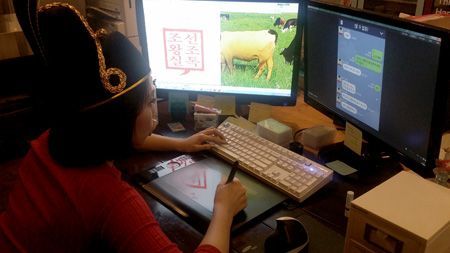
Byun Ji-min works on her webtoon series "Joseon Kingdom Annals Talk" at her home in Ilwon-dong, southern Seoul. /Courtesy of YLAB
She thought Korean history had been taught in an unchanging, boring way, mostly through textbooks. But then she noticed a webtoon that went viral among teens.
“It was screen shots of a chat room where teenagers were role-playing as different fictional characters,” said Byun. “One was playing a rich owner of a big mansion and another a cute maid who visited the mansion for the first time.
“It was popular among teens and different stories kept being updated. They made me realize how effective dialogue can be in relaying stories to readers.”
Byun chose the Joseon Kingdom for her webtoon, not because she was an expert on the kingdom ― she was simply attracted to selective individuals from the kingdom, like a high school girl dazzled by fantasies.
“It was the individual characteristics of several figures from the kingdom that got my attention,” said Byun. “Once I had an interest in them, I began to find out more about them. It was only natural.”
Her list of favorites includes the kingdom’s fourth king, King Sejong; 16th King Injo’s son, Crown Prince Sohyeon; 22nd King Jeongjo; scientist Jang Yeong-sil; and Admiral Yi Sun-sin.
The annals state that King Sejong, her favorite, was a meat lover. She learnt that historians recently found Crown Prince Sohyeon met an unforeseen death because of his father’s fear of being dethroned by his son who loved his people.
King Jeongjo was her “high school sweetheart.” Her class even formed a fan club for the king. She said it was fun and she felt him closer than through textbooks.
It was her webtoon fans that enabled her to launch “Joseon Kingdom Annals Talk” on Naver. She first released the webtoon to the public in August last year on her Facebook webpage.
Posting new episodes daily was her hobby, with a belief that history does not have to be all about epics. But her webtoon became popular and netizens spread it online. Soon, online news outlets began mentioning it. Then Naver offered her a spot on its webtoon platform.
“Joseon Kingdom Annals Talk” debuted on Naver last December.
“If the webtoons I posted on Facebook weren’t interesting, they would have ended as my hobby,” said Byun.
.jpg?w=728)
"Joseon Kingdom Annals Talks" describes King Sejong as a meat lover.
When asked if she had to choose a pop trend other than KakaoTalk to introduce the Joseon Kingdom for another webtoon, she chose Instagram, a social network service where users post photos or videos to share with friends.
“I have four imitation coins that existed in the kingdom,” Byun said. “I took selfies holding the coins and pretended I was a citizen living in the kingdom trying to buy a low-rank servant or a house. It was fun.”
Byun said if she were to make such webtoons, she would have to stick to one-cut scenes, not multiple scenes viewers scroll down, in accordance with Instagram’s format. “Formats control how cartoonists deliver their stories,” she said.
“Scenes of the webtoons I posted on Facebook had to fit in one page because the webpage doesn’t allow a vertically elongated format, so each episode had to be short.
“But with the Naver platform, where such a format is allowed, episodes aren’t restricted by the length of their stories. Naver webtoons also prefer bigger letter sizes for better readability.”
Six years into the profession of cartoonist, Byun plans to keep studying what she likes.
“I don’t want to make masterpieces,” said Byun. “I just want to make cartoons based on things I find interesting in ways people can read easily and joyously.”
To keep pushing “Joseon Kingdom Annals Talk” forward, she said she must study to become familiar with the daily lives in the time period, including international relations with Japan and China, and the coinage system “nyang.”
Byun is fairly fluent in Japanese and is confident she can make episodes that deal with the 1592-98 Japanese invasion of Korea in a more informative and interesting way because she could refer to Japanese historical texts.
“I found from the annals that an assassin was once hired for 15 nyang to kill a king,” she said. “The sum wasn’t even enough to buy a horse at that time. How pathetic the king had to be for someone to pay the assassin only that much money.”