Sweeping anti-graft law passed
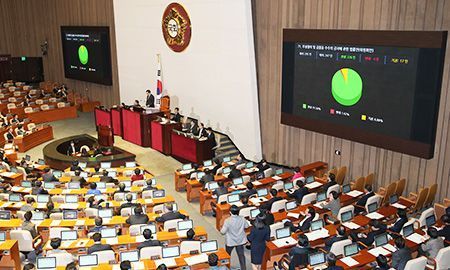
The National Assembly passes a far-reaching anti-corruption bill during a plenary session, Tuesday. A total of 226 of the 247 lawmakers present voted in favor of the bill, while four opposed it and 17 abstained. / Yonhap
Critics claim law contains room for abuse
By Yi Whan-woo
The sweeping anti-corruption law, which was passed by the National Assembly, Tuesday, will eventually create more transparency but initially create some side effects.
At the parliamentary plenary session, 226 of 247 lawmakers present voted in favor of the bill named after Kim Young-ran, a former Supreme Court justice and ex-chairwoman of the Anti-Corruption and Civil Rights Commission (ACRC). Kim first proposed it in August 2012.
The law will take effect from September 2016, following an 18-month grace period.
“A cycle of offering goods will eventually result in receiving favors no matter why the goods were given in the first place,” said former Korean Bar Association (KBA) President Shin Young-moo.
Keum Tae-sup, a lawyer, agreed saying, “It has been a widely practiced business culture that public officials received such treatment.
“The law will be a strong measure for them to be punished regardless of the existence of favors or not.”
Public officials and those at government-affiliated organizations, such as state-run enterprises, will face criminal charges if they receive money, valuables, treatment or services worth at least 1 million won ($908).
Punitive measures will be taken regardless of whether the money or goods were given in return for favors or not. Journalists and private school teachers were included on the bill by the National Assembly National Policy Committee.
The bill also will be applicable to the spouses of the targeted groups.
“There is not much difference between private and public school teachers in terms of their job, and it was right for the lawmakers to include private school teachers as targets.” said Choi Dai-kwon, a professor emeritus at Seoul National University. “Journalists also should be targeted considering they have often asked for financial sponsorship in their reporting for commercial purposes.”
Other experts, however, are concerned the bill is unconstitutional and infringes upon individual freedom.
“The bill would strengthen the investigative power of the prosecution, which already has been criticized for wielding their power excessively,” said Lee Ki-wu, a law school professor at Inha University.
“It’s possible that the government could exploit the measure to monitor and control the people,” he said. “It’s possible that the government could even oppress and those who are against it.”
Song Ki-chun, a law professor at Chonbuk National University, said, “The law enforcement officials will be able to launch investigations at any time against the media that has been critical of the government,” Song said. “The reporters and their companies will be intimidated in their reporting, even if they are found innocent.”