Nowon district chief takes lead in green energy
By Kim Se-jeong
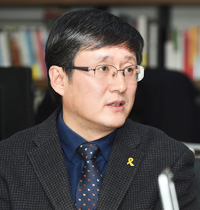
Kim Sung-whan Nowon District Office chief
Some lessons are learned the hard way. This was the case for Kim Sung-whan, chief of Nowon District Office in northeastern Seoul, when it came to green energy.
In November 2011, the district office found asphalt concrete on a road in Wolgye-dong was radioactive and proceeded to remove all 460 tons of the cesium-contaminated concrete. However, it had no place to properly dispose of the waste; the country’s only radioactive waste storage facility in Gyeongju, North Gyeongsang Province, refused to accept it citing complaints from local residents. Amid mounting concerns, the local government moved the composite material twice ― first to an old public swimming pool site and then to one of its compounds ― before finally depositing it in a Gyeongju storage facility last year.
Money was a big issue in the disposal of the waste. Nowon spent 900 million won ($817,067) to get the cesium out of the concrete. The concrete manufacturer was at fault, but the company had gone bankrupt and could not pay for the disposal.
Nowon asked the central government for help, but the request was denied, as the latter deemed the issue was the responsibility of the former.
The district filed a lawsuit, and the Seoul High Court ordered the central government to pay 150 million won of the cost. The central government appealed the case, and Nowon is awaiting a Supreme Court decision.
The meltdown of nuclear reactors at the Fukushima nuclear power plant in Japan earlier that year prompted Kim to be more proactive about energy and the environment.
“It was a good lesson that radioactive materials are dangerous. It convinced me that nuclear energy is not as cheap as it is said to be,” Kim said.
In early 2012, Kim sent out a letter to 234 districts nationwide, calling on them to join together finding ways to reduce the country’s reliance on nuclear energy. Forty-four districts have expressed an interest in collaborating, and today these municipalities are constantly communicating and sharing ideas. They are set to announce a new nuclear energy reduction target in April.
Under Kim’s leadership, Nowon has taken significant steps toward using more green energy.
Distributing mini-solar panels is one of its key projects. Since April last year, the government has been subsidizing the installation of solar panels on apartment verandas. Today, almost 450 apartments have installed the panels.
Building zero-energy housing units is another one of its ambitious projects. When completed in 2016, 121 housing units will be energy self-sufficient. The district office also collects tree twigs and burns them to heat rooms and provide hot water for low-income households.
Kim is a harsh critic of former President Lee Myung-bak, who he said “professed green growth, but ruined the country’s environment with the four-river project.” Lee set out to refurbish four major rivers, and environmentalists say the project seriously harmed the environment.
He is also critical of the incumbent conservative government whose primary goal is “to protect big energy companies.”
Kim criticized his party, the main opposition New Politics Alliance for Democracy, for not having a clear vision about energy policy. “I have to admit that the opposition party is indecisive when it comes to Korea’s future energy policy.”
Kim said Korea has a lot to learn from Germany, which has decided to phase out all nuclear power plants in the country by 2021 after the Fukushima disaster. “Look at what Germany has decided to do,” he said. “Korea is a close neighbor of Japan, but nothing has been done yet.”
Kim is committed to seeing his anti-nuclear energy vision through. “Now, we need to take into account what the earth can offer us. The era for limitless growth is over,” he said.