Oryong sinking remains open sore

Victims’ families protest in front of Sajo Group headquarters in Seodaemun Thursday to demand the fishing giant take greater responsibility for the trawler that sank in the Bering Sea on Dec.1 leaving 27 dead and 26 missing / Korea Times photo by Lee Ji-hye
Victims’ families blame Sajo for ‘manmade’ disaster
By Lee Ji-hye
On a cold afternoon last month, a handful of demonstrators carried signs along a road in downtown Seoul, attracting little attention.
The lack of interest was troubling for the small group, whose loved ones disappeared on Dec. 1 when the Korean-owned trawler Oryong 501 sank in the Bering Sea off the coast of Russia.
Six Koreans were confirmed dead in the sinking of the 1,753-ton vessel; five others remain unaccounted for. In all, 27 men, including Filipinos and Indonesians, have been confirmed dead and 26 are listed as missing.
Some of the Korean family members want the owner of the ship, Sajo Group, held accountable, saying the company sent out a non-seaworthy boat and is evading its responsibilities. They also want the government to apologize for what they believe was lax monitoring of the firm.
“We demand that Sajo Group be punished for letting a malfunctioning fishing boat go out to sea; for an apology from the Ministry of Oceans and Fisheries; and a pledge that the ministry will properly supervise future ocean operations,” said Ko Jang-un, a representative for the families, whose brother has been confirmed dead.
Ma Sun-sook, who also lost her brother, said, “You can’t call it an accident if the sinking of the vessel was predictable.”
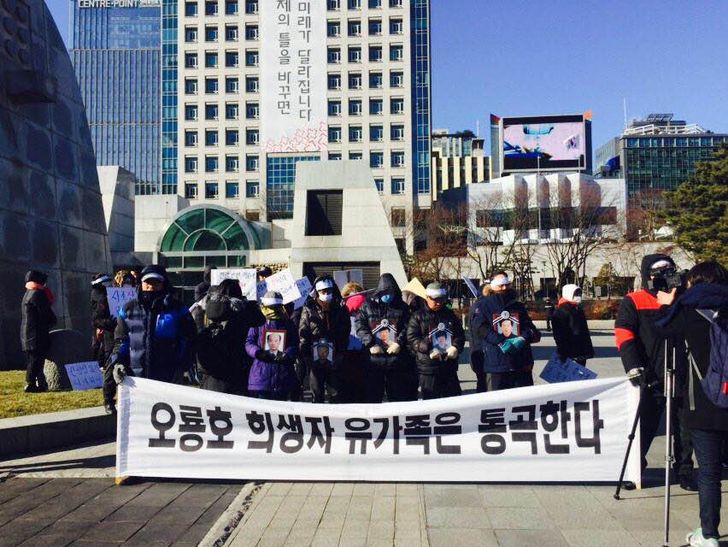
Families protest in front of the government complex in central Seoul last month / Korea Times photo by Lee Ji-hye
According to a Busan Maritime Police (BMP) preliminary report, the boat had been fishing in bad weather before sinking.
About noon, the weather worsened and the call was made to pull a net filled with 20 tons of pollack into the trawler. The report uses the term “forced overfishing” to describe the vessel’s operations during the storm.
Water gushed in, damaging the wooden walls that separated the fish hold from the rest areas for crew. According to the report, the water created a 60x90 centimeter hole in the wall, accelerating the water flow. The trawler’s drainage system malfunctioned, making it “impossible” for the crew to pump out the water. Compounded by the stormy weather, the boat eventually listed and sank, according to the report.
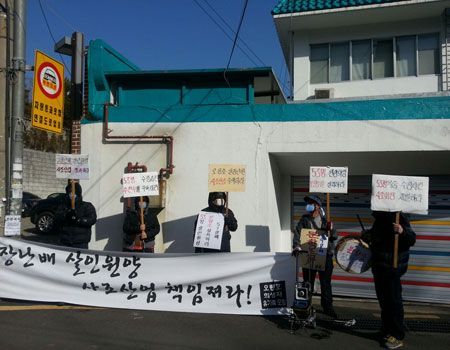
Families protest in the streets of a Sajo official's neighborhood / Korea Times photo by Lee Ji-hye
The Korean Navy sent a patrol ship to search the area after the sinking. However, the families contend that it was not equipped for a rescue mission and that it took four days to arrive, which was confirmed by officials.
The families claim that the faulty drainage system had been known about since a voyage in July, “but the fishing was ordered to continue without any repair.”
A BMP official told The Korea Times that repair shops that had dealt with the vessel before the ill-fated journey confirmed that the drainage system was not working properly.
“Some of our information is based on survivors’ statements, but the fact that the drainage system did not function properly was from repair shops that knew about the condition of the boat,” the official said.
He added that the investigation had reached its final stage as police were determining whether other factors — such as the boat’s condition before sailing — contributed to the sinking. The release date for the final report is yet to be confirmed.
The families also claim that the deceased crew members’ contracts with Sajo ended on Dec. 31, and that they have been told that this absolves Sajo of responsibilities, such as carrying out search operations and providing full compensation.
During a Jan. 13 meeting between the families and the company, Sajo Industries CEO Kim Jung-su told the families that the issue of financial compensation was not negotiable and offered to pay 35 million won ($32,000) to each family.
“We did the best we could, and offered all that we can,” Kim said.
.jpg?w=728)
/ Yonhap
Five of the 11 Korean families chose to accept the compensation and stopped protesting. The rest of the families are camped out in front of Sajo Group’s headquarters in downtown Seoul.
Oh Se-bum, a lawyer providing legal help to the victims’ families, questioned whether the compensation was enough.
“Korea’s Seamen Law states that the responsibility for Sajo is to give them enough money to maintain their livelihood’, which is a completely subjective term,” Oh said.
According to the lawyer, the compensation offer from Sajo was smaller than that bereaved relatives of other recent deadly incidents, such as the Goyang Express Bus Terminal fire, received last year
“The only option these families have is to negotiate for more, because they can’t afford to take it to court,” Oh said. “These people are working-class families and the lawsuit would cost them too much.”
.jpg?w=728)
Families protesting in Gwanghwamun Square / Korea Times photo by Lee Ji-hye
As for the Korean government, it was within the foreign ministry’s power to demand an extension of search operations in Russian waters, the lawyer said.
According to Wang Il-woong, a board member of Sajo Group’s strategic planning department, the search ended on Dec. 31, the last day that the vessel was allowed to be in Russian waters.
“It’s out of our hands because the Russian government has the final say in their waters,” said Wang.
Oh said the foreign ministry did not request an extension for the search from the Russian government. A foreign ministry official declined to comment.
“Only the foreign ministry has the authority to request an extension for search and rescue periods,” Oh said. “Or at least to figure out what exact part of the boat triggered the fatal incident.”