Brace for bumpy ride on City Hall ice rink
/ Yonhap
By Lee Ji-hye
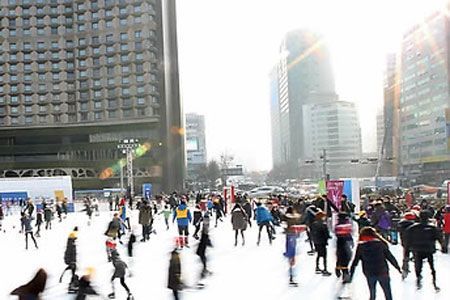
From a distance, the temporary skating rink in front of Seoul City Hall looks like a picturesque sight, but up close, it’s a pock-mocked safety hazard.
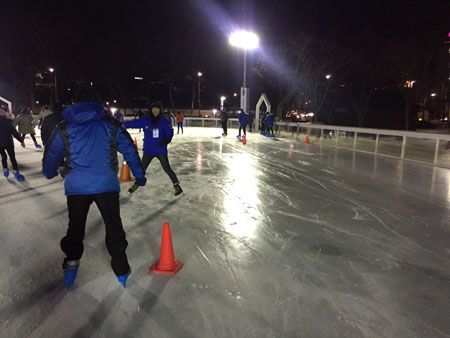
Many sizeable ice divots, two to three centimeters in size, are scattered around the rink. Some are marked by orange safety cones, but most are not, making for an unintended obstacle course that skaters must navigate.
On Wednesday night, a quarter of the rink was off limits because the ice was particularly damaged, posing what the operators of the rink called “safety concerns.” Staffers could be seen filling other holes with ice shavings every hour and pouring water into them in a bid to make the surface smooth.
In a one hour-long period last Saturday, at least four people were carried away on stretchers by staff after falling over due to the holes.
The rink is being jointly operated by the Seoul Metropolitan Government (SMG) and Woori S & P, a sports marketing company affiliated with Woori Bank.
/ Korea Times photo
“This year, conditions seem especially bad,” admitted Lee Gang-su, an officer at SMG’s sports promotion department.
“The city has set up cones as a cautionary measure, but the holes tend to keep forming in the same places, and cracks branch out from other cracks,” he said, adding that professional help is being sought to solve the problem.
Lee added that the rink, which accommodates some 700 people per day, recently began renting out new skates, and that the “ice might not yet be accustomed” to the new equipment.
For skaters, the holes make the experience more like slalom skiing.
“I had to continuously skate around the holes,” said Lee Joon-woo, 17, a high school student. “I saw people falling over, and some had to be carried away.”
He explained that one dent was so deep that an entire blade of a skate could disappear inside it.
.JPG?w=728)
/ Korea Times photo
“But it’s still fun as long as you’re careful,” Lee said.
Heo Hyun-chul, manager of the indoor ice rink at Korea University, commented that weather conditions are a major variable when maintaining an outdoor rink.
“Scratches may appear in both types of ice-skating rinks, but unless children are joking around and dig deeper into one of the cracks, there shouldn’t be any deep holes,” Heo said.
“Cracks with depth are definitely a danger factor for anyone on the rink,” Heo continued. “In the case of professional figure skaters, the rink would be held accountable for their injuries if there were problems on the ice.”
But time is limited for refurbishing of the ice, especially on busy rinks, and some rinks turn to stopgap measures to manage the ice, Heo said.