Labor market reform agreed
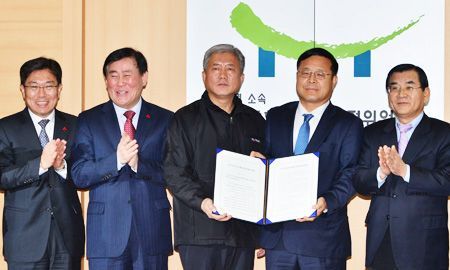
Members of the Economic and Social Development Commission pose at the commission’s office in Seoul, after agreeing on basic principles of reforming the nation’s labor market, Tuesday. They are, from left, Minister of Trade, Industry and Energy Yoon Sang-jik; Finance Minister Choi Kyung-hwan; Federation of Korean Trade Unions President Kim Dong-man; Korea Employer’s Federation Chairman Kim Young-vae; and commission Chairman Kim Dae-hwan. / Yonhap
By Jung Min-ho
Workers, businesses and the government agreed Tuesday on basic principles to reform Korea’s rigid and polarized labor market.
The Economic and Social Development Commission (ESDC) adopted their agreements at the commission’s office in Seoul after the three parties decided to work on 14 detailed objectives across five agendas.
By March, the commission aims to resolve priority issues such as increasing flexibility in the labor market, improving the social safety net and solving income polarization between regular and non-regular workers.
“With the global economy becoming increasingly unpredictable, we need to improve the labor market system to adjust to this new era,” the parties said in a statement.
“Labor market reform is an inevitable task to make the economic system sustainable,” ESDC Chairman Kim Dae-hwan said. “The responsible attitude of the Federation of Korean Trade Union (FKTU) and the Korea Employee’s Federation (KEF) and the government’s patience ended up with a meaningful result.”
This came after President Park Geun-hye called for labor market reforms on Monday. She said it was necessary to help revive the economy next year.
The ESDC, which was established in January 1998, is a social dialogue body that labor, management, government and public interest groups participate in and have consultations on labor, industrial, economic and social policies.
“The agreement is an historic achievement,” said Finance Minister Choi Kyung-hwan. “For making decent jobs, the reforms were essential.”
Previously, the parties failed to reach an agreement on a draft proposal to reform the labor market after days of negotiations.
“Yet, we still have a journey ahead, including the issue of how to find a fine line between flexibility and security of employment,” said the KEF.
The KEF added the income polarization between regular and non-regular workers is the most serious threat to the economy.
The problem stems from, among other things, the overprotection of permanent workers, especially those at well-unionized companies, according to the government. This ironically results in an increase in non-permanent workers like temporaries, part-timers and daily workers, it said.
Today, non-permanent workers make up about one-third of all salaried workers, and they manage to only earn about 55 percent of what their counterparts with regular, permanent jobs do.
The International Monetary Fund warned that Korea’s growth potential could sink to the 2-percent level in 10 years unless it reforms its labor market and addresses problems such as discrimination against non-permanent workers.