US forces chief vows to minimize CFC
By Jun Ji-hye
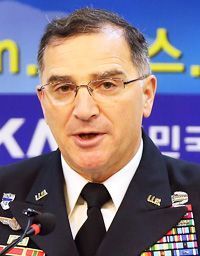
Gen. Curtis Scaparrotti
The chief of U.S. Forces Korea (USFK) said Tuesday he will minimize the size of the Combined Forces Command (CFC) in Yongsan, while moving all other troops to Pyeongtaek to comply with plans to relocate U.S. forces.
Gen. Curtis Scaparrotti, the top commander of the USFK and CFC, said the command would retain its wartime leadership role until Washington and Seoul agree that conditions are conducive for a stable transition of wartime operational control (OPCON) to South Korean troops.
“The CFC headquarters will temporarily remain in Yongsan and maintain the minimum necessary personnel and infrastructure required to command and control operational forces until OPCON transition occurs,” said Scaparrotti.
“Similarly, CFC will keep the U.S. 210th Field Artillery Brigade north of the Han River until the Republic of Korea fields a comparable capability.”
He made the remarks in a lecture at a Seoul hotel organized by the Association of the Republic of Korea Army.
The decision to keep the CFC and the brigade at their current locations was made at the end of last month during an allies’ annual meeting involving defense chiefs.
This provoked controversy here because it meant a change to the Yongsan Relocation Plan (YRP) and the Land Partnership Plan (LPP) designed to move the Yongsan Garrison in central Seoul and the entire 2nd Infantry Division north of Seoul to Pyeongtaek, Gyeonggi Province, by 2016.
Scaparrotti’s remarks appear to be an effort to settle such controversy. “We will continue executing the YRP and LPP, with minimum adjustments due to the OPCON transition requirements,” he said.
Ministry of National Defense spokesman Kim Min-seok said the allies were continuing to discuss how many troops would remain at the CFC.
“Seoul and Washington previously agreed to leave a reasonable number of personnel in Yongsan,” Kim said at a regular briefing. “I believe that Scaparrotti’s use of minimum personnel showed his will to reduce the number further.”
Scaparrott said North Korea had made progress in building asymmetric military capabilities, which required the allies to strengthen their intelligence and ballistic missile defense system.
“Kim Jong-un, unlike his father Kim Jong-il, is overconfident and unpredictable,” he said. “Realizing he cannot win in a conventional war, he has focused his military’s development on training in asymmetric capabilities. I would tell you that the North Korean military is making progress in these areas.”
Asymmetric capabilities refer to, among others, nuclear weapons, ballistic missiles, biochemical weapons and submarines be used to carry out surprise attacks.
Follow Jun Ji-hye on Twitter @TheKopJihye