Summits show shifting ROK-US alliance
By Kang Seung-woo
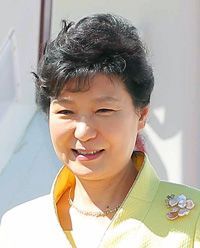
President Park Geun-hye
Is the Korea-U.S. alliance as strong as before?
The question has been raised after two summits President Park Geun-hye had with Chinese President Xi Jinping and U.S. President Barack Obama on the sidelines of the APEC gathering in Beijing.
The Park-Xi summit produced a free trade agreement (FTA), which was hailed as a major landmark for the two key trading partners. Park’s eagerness to get the deal done there produced what has been criticized as an incomplete deal, but showed her desire to get the two nations on an even closer footing.
In contrast, the Park-Obama summit was hastily arranged and produced nothing substantive.
Analysts say that Korea’s alliance is being diversified — the traditional security alliance with the U.S. and an economic partnership with China.
On top of the Korea-China FTA, Park showed strong backing for the Beijing-led Free Trade Area of the Asia-Pacific, which runs counter to the U.S.-initiated Trans-Pacific Partnership.
There will be more tests in the offing which will show more exactly the future of the alliances and partnerships among the three countries.
China is urging Korea to participate in the Asia Infrastructure Investment Bank that Chinese President Xi Jinping hopes to launch next year. This regional bank will play a role similar to that of the World Bank to provide support for development projects in the region, likely helping increase China’s hegemony.
The U.S. is adamant in opposing the bank out of fear that China intends to strengthen its clout in the global financial market and take the lead in reshaping Asia’s economic order.
Park did not give an immediate answer during Monday’s meeting with Xi.
China is concerned about a U.S. possible deployment of its Terminal High-Altitude Area Defense (THAAD) system on Korean soil, which purportedly aims to neutralize Pyongyang’s ballistic missile attacks but, on a large scale, is seen as weakening Beijing’s projection of its nuclear capability. Xi asked Park to tread carefully over the deployment of THAAD batteries during his state visit to Seoul in July, according to diplomatic sources.
China considers THAAD as threat and doesn’t want Korea to accommodate it.
Seoul appears fence-sitting on this issue but it is widely believed that it has no other choice but to yield to the U.S. pressure because of the role it’s playing against North Korea.
“China and the U.S. know Korea relies on them for different purposes,” Paik Hak-soon, a researcher at the Sejong Institute said, adding that that it puts Seoul in a difficult position.
“Korea should be assertive about North Korea and have ourselves better understood in our course of action and not be swept by the clash of the two powers’ interests.”