Free preschool program in jeopardy
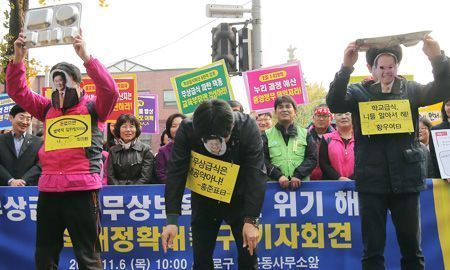
Activists urge the government to increase its budget for free childcare and preschool education programs at a rally near Cheong Wa Dae, Thursday. / Yonhap
By Kim Rahn
Free childcare and preschool education, a key campaign pledge of President Park Geun-hye, is in jeopardy as local governments and educational authorities refuse to offer the provisions, citing budget shortages.
They claim the central government pushed ahead with the populist programs without considering how to finance them, and is now passing the buck to local governments.
Superintendents of regional educational offices said on Thursday they would allocate only a part of their budget for free childcare at daycare centers. They had initially decided not to allocate any money.
In the case of the Gyeonggi Provincial Office of Education (GPOE), it initially refused to set aside any money for the free preschool programs at daycare centers.
Lee Jae-jeong, the GPOE superintendent, said Wednesday that because 1 trillion won would be necessary for the programs, his office would allocate 389 billion won to pay for free kindergartens, but nothing to daycare centers.
In 2013, the country adopted a common education program called the Nuri Curriculum for preschoolers aged from five to seven years. Children at both daycare centers and kindergartens share the same curriculum, although centers are under the jurisdiction of the Health and Welfare Ministry and kindergartens are controlled by the Ministry of Education.
“Next year we will see a 341 billion won reduction in central government funding, partially because of its fall in tax revenue. As we have more free programs to implement, this will cause a 1.5 trillion won deficit to carry out all the programs,” Lee said.
He added that according to the law, his office does not have financial responsibility for the Nuri Curriculum at daycare centers because the centers are basically for childcare, not education, and are thus are under the health ministry’s jurisdiction.
“Our office takes charge of the program at daycare centers because it is the President’s policy. However, we simply do not have enough money.”
The situation in other regions is similar to Gyeonggi Province; most of them are planning to allocate a small part of their budgets for the program at daycare centers.
The problem has been expected: the central government’s financial support to regional educational offices next year will be reduced to 39.5 trillion won, down 1.3 trillion won from this year, with offices forced to cover all the expenses for the program.
Superintendent Min Byeong-heu of the Gangwon Provincial Educational Office said the financial burden has skyrocketed since his office had to cover childcare costs at daycare centers.
“Under the retrenched finance, it is impossible for us to pay for everything. The free program is the President’s campaign pledge, so she should prepare a budget and take responsibility,” he said.
Parents with children attending daycare centers have voiced their opposition to the move. A working mother of two children wrote on the GPOE’s website, “President Park promised free school meals and free education. She lied to be elected. That’s why we badmouth the people who control state affairs.”
Heads of 180 municipalities nationwide also said in a meeting Thursday that they face bankruptcy due to the growing financial burden from welfare policies such as free education and pensions for the elderly.
“The central government is passing the buck of state-initiated policy to local governments, resulting in financial trouble at municipalities,” they said in a statement. “We made it clear that we cannot afford these important policies; it’s not that we don’t want to implement them.”
Responding, the government has criticized the educational offices.
Finance Minister Choi Kyung-hwan said it is irresponsible for the offices to exclude daycare centers in their budgets. “The government told them earlier that if they issue local bonds to cover the costs, the government would buy them back as a part of indirect support.”
Ruling Saenuri Party Chairman Kim Moo-sung said the conflict has resulted from poor finances at both the central and local government levels due to decreases in tax revenue.
“To overcome the financial trouble, educational offices should look into whether their budgets are allocated properly, and whether they spend money on unnecessary projects,” he said.
“If it seems that a proper budget allocation is not enough to overcome the current situation, the central and local governments need to reconsider a priority list of policies.”