N. Korean submarine 'capable of firing ballistic missiles'
By Jun Ji-hye
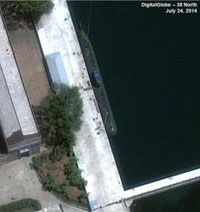
This image, taken from website 38 North, shows a newly identified submarine at the Sinpo South Shipyard on North Korea’s east coast on July 24.
North Korea has built a submarine modeled on a Soviet-era Golf class vessel capable of firing ballistic missiles, military sources said Sunday.
“The North has made an imitation based on the old Soviet model with the knowledge earned through reverse-engineering,” said a military source, asking not to be named.
The vessel is 67 meters long and 6.6 meters wide with a diving displacement of 2,500 to 3,000 tons. Golf class submarines were built in 1958, and were decommissioned in 1990.
The Russian 3,500-ton Golf class sub had three missile tubes that carried R-21 submarine-launched ballistic missiles (SLBMs), a single-stage, liquid-propellant missile with a 1,180-kilogram warhead with a range of up to 1,420 kilometers.
The source said the military began analyzing construction of the submarine in July, adding that the sub had yet to be deployed with its missile-launching capabilities still in question.
It is believed that the vessel can deploy SLBMs in vertical launch systems.
“The government sees the possibility, though it is uncertain about when it can be actually deployed and enter service,” the source said.
He added that the reclusive state had conducted dozens of tests on the ground and at sea at Sinpo South Shipyard, South Hamgyong Province on the east coast, in an effort to mount vertical launch tubes.
“The test facility has been observed by the intelligence networks of South Korea and the United States,” he said.
Last month, the website 38 North, run by the U.S. Korea Institute at the Johns Hopkins School of Advanced International Studies, reported that satellite images had revealed “an unidentified submarine” in a basin at the Sinpo shipyard.
Arms expert Joseph Bermudez Jr. also said in a report at the end of last month that the North had built “a new test stand” at Sinpo to research and develop SLBMs. He said the installation had a 35-by-30-meter concrete pad with a test stand about 12 meters high.
The vertical launch submarine comes about a decade earlier than when the South Korean military planned to complete its own such vessel. Seoul plans to deploy six submarines with vertical launch systems between 2027 and 2030.
Kim Dae-young, a senior research fellow of the Korea Defense and Security Forum, said security concerns would worsen if the North completed the test for the vertical launch of missiles from the sea, although it remains to be seen how the situation will develop.
“If Pyongyang also succeeds in mounting a miniaturized nuclear warhead on a missile, the military power dynamics between the South and North will become unbalanced,” Kim said.
“But the situation regarding the development is still uncertain, meaning that South Korea still has time to prepare. Seoul needs to enhance its submarine capability as well as increasing its number of maritime patrol aircraft.”
Follow Jun Ji-hye on Twitter @TheKopJihye