Nursing school in Malawi sets example

Students at Daeyang Nursing College and Midwifery watch an instructor measuring a baby’s weight in Malawi. / Courtesy of Susie Kim
By Kim Se-jeong
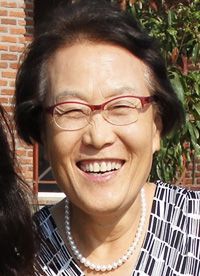
Susie Kim is with Daeyang College of Nursing and Midwifery in Malawi.
When Professor Susie Kim’s Malawi students routinely showed up late for classes, she thought it had something to do with the local culture.
“I explained to them to be on time. But, they were still late, and what’s funny was that they were all late by 15 minutes as if they had agreed,” said Kim, who is the principal at Daeyang College of Nursing and Midwifery in Malawi.
She will be one of the speakers at the third Eulji International Conference on challenges in the nursing profession, hosted by Eulji University. The one-day forum will be held today at the Hotel Riviera in southern Seoul.
She shared her frustrations about her late students with one of her colleagues who said the problem might be that none of them own watches. “He was right. No one was wearing a watch, and for them the sun is their watch,” she said, adding that she eventually apologized to the students.
That was in 2011 when she moved to Malawi to lead the nursing school established by Korean missionary Baek Young-sim.
Established in 2010, the Daeyang College of Nursing and Midwifery has 114 students on full scholarships. Kim’s job entails teaching students, recruiting professors and trainers from around the world, taking care of the day-to-day administration of the school and raising funds for scholarships, food, electricity and water.
Malawi is a landlocked African country about the same size as South Korea. It was never colonized by any European country because it has few natural resources.
But it has poverty and hunger. The school feeds its students three times a day, and that is considered a privilege.
The population consists of more than 10 tribes, each having its own language and culture. Chewa is the most powerful tribe, accounting for roughly 36 percent of population, and its language is taught in primary school. English is a third language spoken in Malawi, but it is a language of the educated.
Apart from malnutrition, HIV and malaria are prevalent.
Baek ran a private clinic in Malawi from 1994. With the help of an anonymous Korean businessman, Baek built the two-story school and invited Kim to be principal.
No one seems more qualified than her.
She earned her degree in nursing, with a specialty in mental health. She got her degree from Boston University in 1978, becoming the first Korean national to earn the highest degree in nursing. Upon her return to Korea, she launched a post-graduate program for nursing in Yonsei University. She has almost 10 years of field experience both in the United States and Korea.
She also has an innate sense of compassion, and her Christian faith helps her maintain it.
While teaching at Ewha Woman’s University in the 1980s, she gave 13 schizophrenics with no means of treatment counseling for several years.
That became the basis for the widely practiced “interpersonal caring” for mentally ill patients, and she received the International Achievement Award in 2001, equivalent to the Nobel Prize in the field of nursing.
The theory laid out 10 different modes of compassionate care-giving, starting with recognizing individuals as they are.
Kim called on nursing professionals, especially nursing teachers, to rekindle the sense of love and compassion and to reach out to people.
She also stressed the importance of clinical experience.
“That’s how you learn intuition, which is all you need when caring for patients. There are many good theories. But, without providing actual care, nursing is useless,” she said.
“Nursing education has to be reformed. And if you want to train nurses, field experience is imperative. Without the real experience, you cannot teach your trainees to learn and to act.”
Kim was born in Yeosu, South Jeolla Province in 1942. A rebellion by soldiers in 1948 that took place in Yeosu and Suncheon in South Jeolla Province against the Syngman Rhee government motivated her to be a nurse.
“At the peak of the rebellion, her family and the rest of villagers were confined in a classroom at my school,” she said. “Rebels carried on massive shootings of who they considered traitors, and one wounded young guy escaped into the classroom.
“One woman among the crowd came forward and stanched the bleeding on his thigh with a long patch. He was unconscious because of the excessive loss of blood. She took care of him the whole night until he woke up the next day. Watching that, I told myself Ibecome a nurse, and that hasn’t changed.”
Her school receives volunteers from domestic and international non government organizations and the Korea International Cooperation Agency. But she said her school still needs help. Besides nursing professionals, the school is in need of people who can fix computers and medical equipment, and teach agricultural and taekwondo.