Migrant farm workers face systemic abuses: Amnesty International
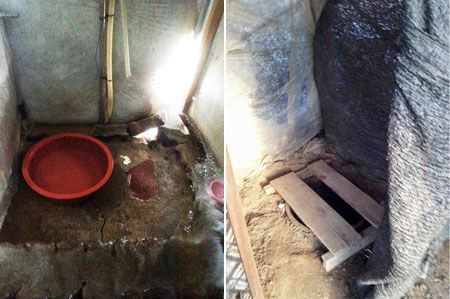
Migrant farm workers in South Korea are often provided with substandard accommodation including inadequate toilet and shower facilities. / Courtesy of Amnesty International
By Kim Hyo-jin, Kim Young-jin
Migrant farmers in Korea face a wide range of human rights abuses including inhumane working hours and physical abuse, Amnesty International said Monday.
In a report, Amnesty called on the government to monitor the agriculture industry, saying laborers from countries such as Cambodia and Vietnam are subject to forced labor and lack the means to escape the situation.
“The Employment Permit System (EPS) includes severe restrictions on migrants’ ability to change jobs. This government-run system puts migrant workers into trafficking for exploitation and forced labor,” Byun Jeong-pil, 38, a campaign manager told The Korea Times.
“Migrant farm workers are compelled to work in conditions that they didn’t agree to. The South Korean government should be aware that the workers can’t get out of this coercive mechanism.
Amnesty held a press conference at the National Assembly to publicize the report, titled “Bitter Harvest.”
Based on interviews conducted over the course of 14 months, the report says the laborers work more than 10 hours a day and sometimes much more and receive only two days off per month. Moreover, they live in squalid conditions and often face intimidation and violence from managers.
“I regularly worked from 6 a.m. to midnight with only an hour for lunch,” the report quoted a Cambodian worker as saying.
“The employer got angry anytime we took a break to stretch our body. So when I felt a sharp pain, I had to stand up when he wasn’t looking and did it quickly I didn’t dare to linger.
“It was unfair because the Korean workers were allowed to rest but not us migrants,” the worker said.
Another Cambodian, identified as CF, said the Gyeonggi Province farm he worked at lacked proper toilet facilities.
“We had to dig a hole in the ground to do our business. When that filled up, we dug another. My employer also paid me late once every two months or in installments.”
A 33-year-old Vietnamese woman identified as GT claimed that she and a colleague suffered physical violence.
“One day my Vietnamese colleague felt ill so she lay in bed and didn’t come to work. My boss stormed into the room and hit her, pulled her hair, scratched her neck. It bled. Because I tried to stop him hitting my colleague, my boss swore at me and punched my shoulder three times,” she said.
The reported abuses call attention to the EPS, a government-run scheme designed to provide migrant workers to small- and medium-sized companies. Critics fear that the system allows for labor abuses and makes it difficult for workers to change jobs.
Norma Kang Muico, Asia-Pacific Migrant Rights Researcher at AI, said the migrants are excluded from key legal protections relating to working hours, weekends and daily breaks afforded to most of the country’s workforce due to an exemption article of the Labor Standard Act.
Muico said the EPS favors employers over worker’s rights. Under the system, migrants must obtain a release form signed by their employer in order to change jobs. However, employers can terminate a migrant’s contract without having to justify the decision, she said.
Rather than giving a release letter, their employer tends to threaten to report them to the immigration authorities as “runaways,” which would make them subject to arrest or deportation.
NR, a 23-year-old Cambodian woman, told AI that when she asked her employer to sign her release document, “he got very angry with me and slapped my head and pushed me.”
The report said that abused workers are discouraged from making official complaints against their employers. On Cambodian worker who claimed that he was abused, for example, was simply advised by a case worker to apologize and make peace with his employer.
Muico recommended that the government bolster its monitoring of the EPS system and better train employers to avoid labor abuses.
“No one wants to eat kimchi made in China. Koreans want made-in-Korea food. Migrant workers are willing to work here. Protecting migrant workers should be implemented not just in law, but in practice,” said the researcher. “This would be a win-win mechanism.”