S-N rivalry to ease for now

Unification Minister Ryoo Kihl-jae, right, and North Korean official Kim Yang-gon walk toward a restaurant in Incheon, Saturday, hours after the high-level North Korean delegation arrived in the port city for the closing ceremony of the 2014 Asian Games. / Yonhap
By Jun Ji-hye
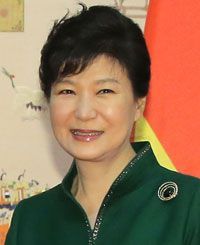
President Park Geun-hye
The surprise visit by three top aides of North Korea leader Kim Jong-un has thrown the spotlight on whether the two Koreas can achieve any improvement in their strained relations.
It remains to be seen whether North Korea’s abrupt peace offensive, which came just days after Pyongyang harshly criticized President Park Geun-hye for a speech she gave at the United Nations on the subject of unification, can facilitate Park’s initiative to achieve a unified Korea.
Commentators said that the Saturday visit of the North’s military-party delegation ― headed by Hwang Pyong-so, believed to be the Pyongyang’s second most powerful man, along with Choe Ryong-hae, the Workers’ Party of Korea secretary, and Kim Yang-gon who is in charge of Pyongyang’s relations with Seoul ― has provided momentum toward establishing constructive dialogue between the two Koreas.
To maintain the diplomatic thaw, a round of high-level talks, which Seoul and Pyongyang agreed to hold in late October or early November, will serve as a significant watershed, experts said.
Inter-Korean relations showed some signs of a thaw during previous high-level talks in February, but these soon became frosty again after the isolated state reacted strongly to Seoul and Washington’s joint military exercise that began at the end of that month.
“The next talks are expected to be held as agreed, and both the South and North will try to make some results there because they are aware that another deadlock in handling the inter-Korean relations will burden both sides,” said Park Young-ho, a senior researcher at the Korea Institute for National Unification.
“Pyongyang obviously wants to show off some sort of achievement following the dispatch of three high-ranking officials. Likewise, Seoul probably feels the need to regard the talks as an opportunity to promote President Park Geun-hye’s persuasive analogy of unification as a bonanza,” he said.
According to an official from the Ministry of Unification, the two sides agreed to speak frankly at the high-level talks to resolve various pending issues including holding an event for the reunion of relatives separated by the 1950-53 Korean War.
President Park suggested holding a reunion event during her speech commemorating the National Liberation Day that fell on Aug. 15, but the North has yet to reply to this proposal.
“There is a greater possibility that the government will push for the reunions as a top priority during the talks,” said Park.
Meanwhile, the North is expected to call for the lifting of sanctions imposed on May 24, 2010 and a resumption of tours to Mount Geumgang, he added.
Koh Yoo-hwan, a professor of North Korean Studies at Dongguk University, agreed in part with Park.
“The North will likely concentrate on softening the sanctions as it might feel that those are the biggest obstacles to recovering inter-Korean relations,” he said.
Both experts agreed that the government would not be able to comply with all the requests made by the North, but it is sending the North a signal that it has willingness to resolve pending problems through communication.
However, a negative outlook still remains because there seems only a small chance that the reclusive state will halt or slow its nuclear ambitions, which has been the biggest setback to inter-Korean relations.
The so-called May 24 Measures, imposed by former President Lee Myung-bak after the North torpedoed the South Korean frigate, Cheonan, in March 2010, froze nearly all government-level interaction and aid for Pyongyang.
The tour program to the North’s scenic mountain has been on hold since July, 2008 when a female South Korean tourist was shot dead by a North Korean soldier.
Follow Jun Ji-hye on Twitter @TheKopJihye