'CSAT English test will become easier'
By Jung Min-ho
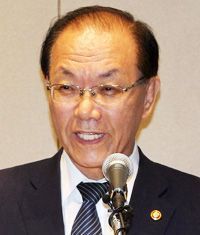
Hwang Woo-yeo Education Minister
Education Minister Hwang Woo-yeo said Wednesday that the ministry would most likely reform its scoring system for the English section of the nation’s university entrance exam.
The ministry said the test would probably get much easier, and would focus more on practical communication skills.
Currently, test-takers receive one of nine grades and only the top 4 percent can attain the highest grade.
Hwang indicated that more students would be able to attain the higher grades if the proposed reforms were to go ahead. The new “absolute scoring” system could replace the “relative scoring” system as early as 2018, he said.
“Students are wasting too much time and money to get the first grade on the English section of the College Scholastic Ability Test (CSAT),” he told reporters. “I wonder who the excessive spending on English education is actually for. We need to correct the system.”
The ministry said it would work with outside experts to map out a detailed plan before announcing it sometime this year or next.
The current English test has long been criticized for lacking practical relevance, with many critics saying it focuses excessively on reading skills at the expense of speaking and writing skills.
Hwang said English education would change so as to be more practical and communication-oriented.
“We are not trying to teach all students to the level of an English linguist, are we?” he asked. “In high school, they just need to learn how to communicate in English. They can learn beyond that level after they graduate, if they want.”
Another reason for the proposed reforms is to cut spending on private education. Some research agencies estimate that Koreans spend 15 trillion won ($15 billion) on English education annually.
In February, the ministry announced that the new English test would be easier.
Yet critics of the proposed reforms say making the English test easier is unlikely to advance the goal of cutting spending on private education. Instead, some argue, Koreans will spend their money to study other subjects.
The plan is reminiscent of a policy failure concerning the National English Ability Test (NEAT), an Internet-based, TOEIC-style exam that debuted in 2012.
Under the Lee Myung-bak administration, the ministry considered replacing the English-language section of the CSAT with the state-administered test. High scores on the NEAT would help applicants seeking university admission, in the same way that high TOEIC and TOEFL scores do now.
However, the plan was scrapped after President Park Geun-hye was inaugurated in 2013.
The primary stated goal of the NEAT was to address concerns about growing household spending on English education. However, the exam triggered greater zeal for English among parents and students, pushing educational costs higher and becoming yet another burden for students preparing for college admission.