Domestic anti-submarine torpedo successfully test-fired
By Jun Ji-hye
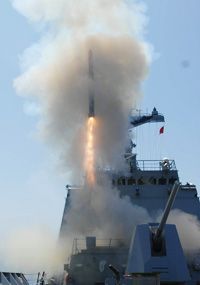
Hongsangeo torpedo being launched / Courtesy of DAPA
The Defense Acquisition Program Administration (DAPA) said Monday that it successfully test-fired an indigenous anti-submarine torpedo, paving the way for its long-delayed mass production.
In test firings on May 7 and 23, the Hongsangeo, or “Red Shark” torpedo hit its intended underwater targets three straight times, DAPA said. The success came after two earlier failures.
“The three straight successes prove that complaints about product quality raised by the Navy in August 2012 have been answered,” said a DAPA official. “Improvements have stopped the malfunction of components resulting from water entry impact.”
The official added that mass production of the torpedo will likely begin next month.
DAPA and other defense agencies including the Agency for Defense Development (ADD) have jointly conducted technology analysis and performance tests over the past two years after receiving complaints from the Navy.
These came after one Hongsangeo failed to hit its target and went missing during testing in July 2012.
Following the failure, five Hongsangeo practice torpedoes and three live ones were fired between September 2012 and February 2013. However, the result was not satisfactory as only five hit the targets, marking a 62.5 percent accuracy rate.
For combat deployment, tests should meet more than a 75 percent accuracy rate.
Among two practice Hongsangeo torpedoes and two live ones tested between July and September last year, three of them hit their targets, while one live one failed.
The total of 15 firings during the tests conducted from September 2012 showed a 73 percent accuracy rate, slightly lower than international standards.
But DAPA officials made clear that there would be no problem in mass production.
“Achieving three consecutive successes is more difficult than meeting a 75 percent accuracy rate,” the official said.
DAPA head Lee Yong-geol said the agency will spare no efforts to improve relevant systems to allocate precisely guided weapons to the military.
“Like other developed countries, we will utilize various data accumulated during live-fire exercises and try to reflect state-of-the-art technology for continuous performance improvement,” he said.
ADD spent 100 billion won ($98 million) to develop the 5.7-meter torpedo. One torpedo costs around 1.8 billion won.
Follow Jun Ji-hye on Twitter @TheKopJihye