Meteorites' ownership remains uncertain
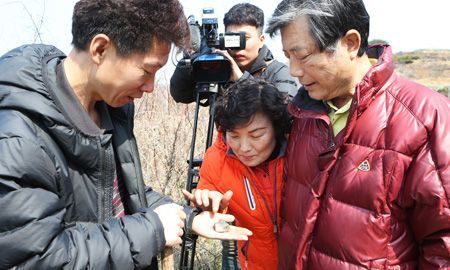
Meteorite hunters examine a rock they found in a field in Jinju, South Gyeongsang Province, Sunday, near the site where a meteorite weighing 9.36 kilograms was found. / Yonhap
‘Space rocks’ may be designated as natural monuments
By Kim Da-ye
To whom do two meteorites that fell to Earth and landed on a local farm belong?
According to the Cultural Heritage Administration (CHA), the answer to this question remains uncertain for now because it has to examine the law in order to decide who really owns them.
After confirmation that the two rocks found after fireballs were observed on March 9 were meteorites, there has been a rush to the areas in Jinju, South Gyeongsang Province, to hunt for the possibly valuable pieces of rock. The area drew not only curious Koreans, but also foreign “meteorite hunters” over the weekend, according to the Korea Polar Research Institute (KOPRI).
“The media reported that meteorites are owned by those who find them. But we are reviewing the law to determine who has ownership,” said an official at the CHA.
Meteorites are more rare than gold, and therefore reportedly more valuable than the precious metal. They are priced per gram or kilogram, and values vary, depending on several factors including of what they consist.
The cultural heritage authority asked the customs office on Monday to ban any meteorites found in Korea from being removed from the country after it decided they are cultural properties worthy of protection.
The authority will examine the meteorites further to decide whether to designate them as natural monuments or not.
The KOPRI confirmed Sunday that the two meteorites found in Jinju are categorized as ordinary chondrites, the most common type. They contain a high concentration of iron.
One meteorite weighing 9.36 kilograms was discovered on March 10 in the greenhouse of a 57-year-old farmer, while the other one weighing 4.1 kilograms was found nearby a day later by an 80-year-old man.
Both are currently being kept by the KOPRI, which cut part of them and examined them under an agreement with the two people who found them.
The media reported that a rock assumed to be a third meteorite was found Sunday near the second site, although the KOPRI is yet to confirm that information.
“The meteorites found in Jinju are believed to have been broken into two pieces or more while passing through the atmosphere, so it is likely that there are more,” the KOPRI said in a statement.
The last time a meteorite was found in Korea before the recent case is 71 years ago on Nov. 23, 1943.
The meteorite, found in Goheung-gun, South Jeolla Province, was named Doowon and weighs 2.12 kilograms. It is owned by a Japanese man, and the Korean government borrowed it from him and kept it at the Geological Museum of the Korea Institute of Geoscience and Mineral Resources.