Criticism against NHK boss escalates
By Jun Ji-hye
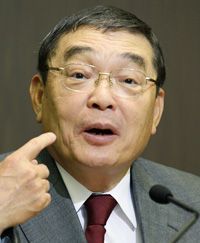
NHK President Katsuto Momii
New NHK President Katsuto Momii said Monday he regrets his controversial remarks justifying Japan’s use of sex slaves during World War II, but his apology was insufficient to curb public uproar in Korea.
According to the Kyodo news agency, Momii attempted to quell mounting criticism against him, saying, “My remarks were very improper. I should not have made such comments. Those were just my personal opinion.”
The apology came after Momii said in his first news conference on Saturday that, “The practice of comfort women was common in any country that was at war, including France and Germany.”
Lawmakers and citizens here collectively condemned the new head of Japan’s national broadcaster, demanding that he step down from his post.
His remarks furthered outraged Koreans who were mourning Hwang Geum-ja, a 91-year-old victim of the Japanese military’s sexual slavery who died on Sunday.
Members of the ruling Saenuri Party and the main opposition Democratic Party (DP) were united in saying that the Japanese government should make an official apology about the improper comments and Momii should step down.
“Tokyo should be sure to remember that, after all surviving victims pass away, the country will remain in history as an assailant without self-reflection,” said Rep. Hwang Woo-yea, chairman of the governing party.
Supreme Council member Lee Hye-hoon said, “I feel so sad that the last words the late Hwang Geum-ja heard from a Japanese high-ranking official were Momii’s thoughtless remarks.”
Lee added, if the Japanese administration has any conscience, it should be ashamed that a person like Momii is the head of a public TV station. She called on Japan to dismiss him.
DP members joined the criticism. Chairman Rep. Kim Han-gil said, “The lifelong wish of the late Hwang was to receive an apology from Tokyo. I am so sorry that nobody apologized to her before she died.”
The chairman took aim at the NHK head, saying continuous absurd remarks like his will only serve to reinforce the historical fact that “the country was a war criminal.”
DP floor leader Rep. Jun Byung-hun said Momii’s comments once again showed that the way history viewed by leaders in Japanese society is just vulgar and inhumane, as also evidenced by Prime Minister Shinzo Abe’s visit last month to the Yasukuni Shrine, which houses 14 Class-A war criminals.
Citizens expressed their anger through social network services.
A Twitter user with the ID “p020***” claimed, “Momii is like a beast that does not have a conscience and morality. The Japanese government should not tolerate him as a head of public television. Among sex slave victims, there were even small girls aged less than 13 years old.”
Another with the ID “opent*****” said, “I feel my heart swelling with indignation. We will fight till the end so that surviving victims receive Japan’s apology.”
Reports from international media outlets were also negative.
“As a publicly funded broadcaster, NHK is supposed to be politically neutral,” BBC correspondent Rupert Wingfield-Hayes in Tokyo said. “It was a shock when its new chairman started expressing very political views in his very first news conference.”