Stronger Korea: Manual to becoming better nation
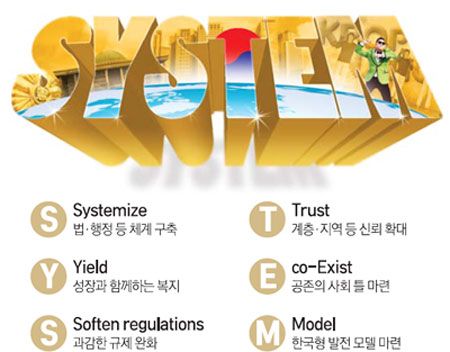
By Ko Dong-hwan
Internet Hankook Ilbo _ Hankooki.com _ ended its series of articles under the title “Changing National System” which began back in March 18.
The series first delineated problems that Korea’s national system has: excessive and recessive political plays; haughty National Assembly deterring economical growth; deepening polarization; unstable social safety networks; and chronic corruption.
Kang Bong-gyun, endowed chair professor of Kunsan National University, said, “Unless the broken system is treated, passing the threshold of developed countries will be difficult.”
Specialists suggested several politico-grained solutions in front of the dilapidating nation.
First, it must establish laws and social safety networks that are fundamentally strong and based on reasonable grounds. Second, it must make up a cultural environment that doesn’t singularly focus on few elite groups but encompasses entire citizenship and acknowledges differences in voices. Third, it must keep watch over political consistency and maintain justice among upper political echelons.
Overall, “trust” matters the most in realizing the citizenry coexistence in Korea.
A past article from the “Changing National System” on March 18 introduced a survey result that “Two out of three consider Korea opaque and untrustworthy.” It connotes that most Koreans keep unfaithful views towards the National Assembly and Korea’s judiciary and financial units at the governmental level.
Specialists also mentioned that Korea must stop hastily employing national systems from other developed countries, like welfare policies, because that only leads to failure sooner than later. Instead, it must start building a unique “Korean-type systematic model” that matches the nation’s idiosyncratic structure the most.