Park unlikely to visit Japan soon
By Kim Tae-gyu
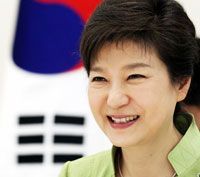
Park Geun-hye
In spite of an open request, the chances of a summit between President Park Geun-hye and Japanese Prime Minister Shinzo Abe appear to be shrinking as Japanese politicians continue to make provocative remarks.
Domestic analysts said Wednesday that Park will not be able to meet Abe at a time when Korean people’s sentiments against Japan have significantly worsened because of the recent problematic comments of Japanese leaders.
“I don’t think that Park will meet Abe soon although the latter officially requested it because people’s sentiments against Japan hit a nadir of late,” said Prof. Shin Yul at Myongji University.
“Park must remember that diplomacy is strongly correlated to domestic politics. In my view, she should not meet Abe this year. Otherwise, she risks experiencing a great backlash.”
During his tour of Southeast Asian countries, Abe said last Saturday that he hopes to hold his first summit with Park to mend the fence with Seoul.
He said that Korea is the most important neighbor for the island nation and discussions are currently underway between diplomats of both countries, prompting conjecture that a summit is being arranged.
“I have had a telephone conversation with President Park Geun-hye. We belong to the same generation so I sincerely hope that we will be able to hold a summit,” he said.
Relations between the two countries have become strained of late because senior Japanese bureaucrats and politicians have made controversial comments, which critics say are without contrition for its colonial misdeeds.
The diplomatic discord started just after Abe took power late last year because the ultra rightist has angered Koreans with a series of words negating its past wrongdoing as well as renewing its territorial claims to the Korean islets, Dokdo.
He also sided with the decision of his lieutenants who visited the controversial Yasukuni Shrine, where many Class-A war criminals are buried. These visits generated a great outcry from its neighbors and victims of its imperialistic atrocities.
In this climate, Prof. Shin said that only after Japanese leaders show real regret for the actions of the past and put an end to provocative remarks can a summit be held.
After being inaugurated, Korean presidents have typically selected the United States as the first place they visit with Japan as their second destination.
Park, who took office in February, followed the first part of the tradition because she flew to Washington in early May but has so far avoided visiting Tokyo.
Instead, Park visited China in June and plans a trip to Russia in September to participate in the G20 Summit. But she has no immediate plan to visit Japan, according to Cheong Wa Dae officials.
Cheong Wa Dae said that the phone call between Park and Abe took place in early March when the latter congratulated the former on her inauguration. Regarding the summit talks it also claims that there has been no official request from Japan to that effect.