Heavy rain pounds Seoul
Downpour expected until Wed.
By Kang Seung-woo
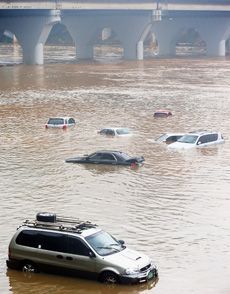
Vehicles at a parking site at Han River in Jamsil, southern Seoul, are submerged in flood waters Monday, as heavy rains hit the capital city early in the morning. The Korean Meteorological Administration expects more rain to hit the central part of the peninsula until Wednesday. / Yonhap
An overnight heavy rain caused serious flood damages in some areas of Seoul and plagued commuters Monday morning due to shutdowns of major roads.
According to the Korea Meteorological Administration (KMA), more than 140 millimeters of rain from midnight to 10 a.m. fell in some southern parts of the capital city, with Songpa-gu and Gangnam-gu receiving 144.5 and 141.5 millimeters of precipitation, respectively.
Between 10 and 20 centimeters of rain submerged parts of pedestrian roads near Gangnam and Sadang stations in southern Seoul, which forced commuters to face a tough way to work.
Due to high water levels, parts of roads near the Yangjae and Cheonggye streams, as well as the Jamsu Bridge over the Han River were closed temporarily early in the morning, triggering a heavy traffic jam.
Although no casualty was reported in Seoul, people taking a walk along streams were rescued after being isolated by rising floodwaters. A 64-year-old woman was rescued after being temporarily isolated near a river stream in southwestern Seoul, when flooded waters rushed through a nearby pedestrian road, police said.
Dozens of cars at a parking lot in Tancheon were submerged in water.
Heavy rain until Wednesday
Meanwhile, since the rainy season arrived on the Korean Peninsula on June 17, the monsoon system does not seem to be ceasing yet.
The weather administration said the seasonal rain is slowly moving, so torrential downpour is expected to hit the central region until Wednesday, with up to 200 millimeters of rain forecast to drop in some areas in Gyeonggi and Gangwon Province.
Most of the southern part of the peninsula, which is, on the contrary, suffering from scorching hot weather, will receive a long-awaited rain between Thursday and Sunday.
With this year’s monsoon season beginning one week earlier than usual, the KMA foresaw it would be over around Thursday, given that the average period of rainy season over the past 30 years was 32.
However, with the rain front likely to go south until Jeju Island, the rainy season is likely to extend further.
In general, the seasonal rain front weakens and clears up by moving up toward North Korea, pushed by expanding North Pacific anticyclone.
As a result, it is expected to rain throughout the country next week as the seasonal rain front will move back up north.