2 cub Asiatic black bears to be released in October
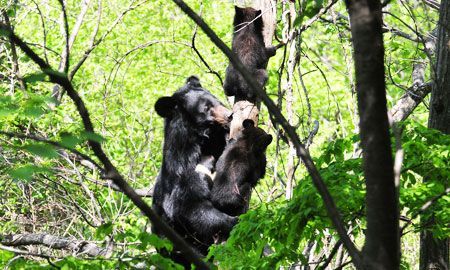
Asiatic black bear
By Nam Hyun-woo
Two juvenile Asiatic black bears will be released on Mt. Jiri in October to increase the population of the endangered species in the southern mountain, the Ministry of Environment said Wednesday.
According to the ministry, the two male cubs are training with their mother bear to acclimatize to wildlife. If the introduction goes successfully, the number of bears staying in the mount will be 29.
The cubs were born through natural breeding on Jan. 7 at a training field in the Species Restoration Center (SRC) in Mt. Jiri.
The mother bear, tagged RF-4, is a 9-year-old Asiatic black bear, imported from Russia in 2004. It was reintroduced into wild in October that year, but found wounded after trapped in a noose.
It became so used to humans during its treatment and staffers at the center have decided never to release it into the wild. The father bear, called Cheonwang, also lives in the center and mainly serves procreation purposes.
The two juvenile bears have not yet been designated and learning to climb, hunting and feed searching, according to Lee Yoon-soo, an official at SRC.
Asiatic black bears are enlisted as endangered species by the ministry.
The last officially recorded wild Asiatic black bear was shot and killed by a poacher on Mt. Sorak in 1983.
In 2004, the Ministry, which supervises SRC, launched the Asiatic Black Bear Restoration Project, aimed at raising the species’ population to 50 by 2020.
“The figure 50 is the minimum population for a species to survive more than a century by reproduction. Fortunately, including the newly born two cubs, the number of bears on Mt. Jiri is increasing. But at the same time, reaching the goal is not an easy matter, requiring huge efforts,” said Lee.
In January, another two Asiatic black bear were born, showing the species is stably reproducing on the mountain.