Korea joins global anti-corruption effort
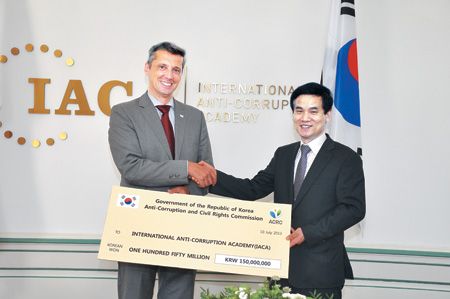
Anti-Corruption and Civil Rights Commission (ACRC) Chairman Lee Sung-bo, right, shakes hands with International Anti-Corruption Academy chief Martin Kreutner during the ceremony marking the commission’s donation of 149.2 million won (102,000 euros) to the academy held in Laxenburg, Austria, July 10. / Courtesy of ACRC
By Kim Tae-gyu
The Anti-Corruption and Civil Rights Commission (ACRC) has donated more than 100,000 euros to a global initiative tackling corruption in a bid to be part of United Nations efforts.
The ACRC said Monday that its Chairman Lee Sung-bo participated in an event marking the donation of 149.2 million won (102,000 euros) to the International Anti-Corruption Academy (IACA) late last week.
“IACA is the first international organization specialized in anti-corruption training, and the ACRC fully supports the academy’s core visions including an inter-disciplinary approach to corruption, and bridging the gap between theory and practice,” he said at the donation ceremony.
“For a more active partnership, the ACRC signed a memorandum of understanding with the academy in 2012, and offered financial contributions this April. We are also considering providing human resources through secondment.”
The IACA is an international organization, established in 2010 in Austria’s Laxenburg. Korea joined later in the year and promised to donate 102,000 euros in late 2012.
It strives to support the global struggle against corruption through dealing with a lack of knowledge and practice in the area. Its main mission is to educate people on anti-corruption policies and train professionals.
The United Nations Office on Drugs and Crime (UNODC) spearheaded the launch of the IACA, which is currently headed by Martin Kreutner. It is famous for its course of nurturing masters in anti-corruption studies.
Underrated country
Lee visited the UNODC in Vienna to discuss issues such as the United Nations Convention Against Corruption and Anti-Bribery Convention set up by the Organization for Economic Cooperation and Development.
He also went to Transparency International (TI) in Berlin, which announces a corruption perceptions index (CPI) every year.
Based on experts’ assessments and opinion surveys, TI has published the CPI since 1995; it ranked 176 countries last year on a scale from 100 to 0. The higher the figure is, the cleaner the country is.
Last year, the CPI was decided on more than 10 different evaluations from a dozen institutions including the Economist Intelligence Unit, Global Insight and the World Economic Forum.
It measures perception of corruption to rank the countries surveyed. It is believed to be very accurate because it shows a strong correlation with proxies for corruption such as black market activity.
Korea was ranked 45th out of 176 countries. The ranking was not so bad but not so impressive, either.
Lee thinks that there is room for improvement. More precisely, he believes that Korea is underrated and tried to let TI understand its proactive anti-corruption efforts.
“Korea is strengthening its punishment of corrupt bureaucrats as well as substantially seeking better integrity standards. Lee explained such a policy,” an ACRC official said.
“In addition, the country has introduced the new accounting rules to better regulate any attempts to gain profits through corruption. The new atmosphere of our judiciary system in punishing corporate wrongdoing is also an issue.”
IFRS
Beginning in 2011, listed companies of Asia’s No. 4 economy fully adopted the International Financial Reporting Standard (IFRS), a principle-based accounting rule aimed at jacking up the transparency of companies.
Adopting the IFRS is designed to take the country’s accounting transparency to a new level at a time when the world is wary about the topic in the wake of the global financial crisis.
“Accounting transparency has emerged as one of the most significant post-crisis challenges with the recognition that financial stability and a cleaner corporate culture cannot be achieved without it,” a Seoul analyst said.
“It is a big step forward in terms of the country’s efforts to move toward a cleaner society.”
Observers also pointed out that the ACRC’s attempt to pass the bill this year geared toward more efficiently preventing unlawful requests and conflicts of interests will mark a crucial momentum in the country’s anti-corruption schemes.
If the bill wins parliamentary approval, bribed bureaucrats will be subject to severe punishment even if the bribes have nothing to do with their work.
Who is ACRC Chairman Lee Sung-bo?
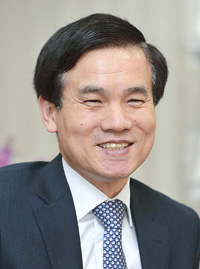
ACRC Chairman Lee Sung-bo
Anti-Corruption and Civil Rights Commission (ACRC) Chairman Lee Sung-bo served as a judge for some three decades before taking charge of the organization late last year.
After majoring in law at Seoul National University, Lee passed the bar exam in 1978 and became a life-time judge. His career culminated in 2012 when he took the stewardship of the Seoul Central District Court.
He was tasked with leading the ACRC in consideration of his reputation as an avid supporter of the rights of minorities and the socially weak.
“The ACRC should work harder to safeguard the rights and interests of people and achieve a more transparent and fairer society from the perspective of the public,” he said in his inaugural speech.
“The main mission of the ACRC is to protect the rights of minorities and the socially marginalized so that they cannot be unduly infringed upon. I will put forth efforts to attain this goal.”
The ACRC was established in February 2008 through the consolidation of the Ombusman of Korea, the Korea Independent Commission against Corruption and the Administrative Appeals Commission.
The integration of the three state-run organizations enabled citizens to enjoy one-stop services in addressing public complaints, filing administrative appeals and fighting corruption.