Park stresses consumer market ties
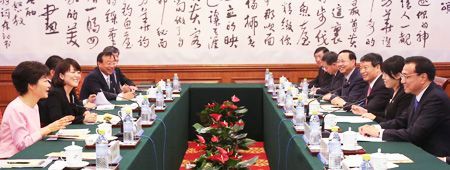
President Park Geun-hye, left, talks to Chinese Premier Le Keqiang, right, during a meeting in Diaoyutai State Guest House in Beijing, Friday. Park and Le agreed to beef up economic and financial partnerships between South Korea and China in the two-hour meeting. / Yonhap
By Kim Tae-gyu
BEIJING ― President Park Geun-hye called for stronger economic ties with China and asked Korean firms to invest in China’s large-scale projects to develop its western areas.
She made the calls during a forum with hundreds of Korean and Chinese businesspeople here on Friday.
"South Korea and China should design a new vision for economic cooperation and make a leap toward qualitative growth beyond quantitative growth," Park said.
China is South Korea’s largest trade partner but the latter has cared more about the former’s markets for machinery and other capital goods or parts than those for consumers.
Park wants to shift the economic cooperation toward consumer goods and domestic-demand oriented fields.
“The trade between the two countries mostly comprises intermediate products and components, which are necessary to roll out final goods to be exported to North America or Europe,” Park said. “Hence, the bilateral trades were greatly affected by the economic situations in the final export destinations. Now, the two countries are required to tap into the domestic markets of each other so that they will be able to establish stable trade not vulnerable to outside factors,” she said.
Toward that end, Park fixed her eyes on China’s western development projects of modernizing its six provinces of Gansu, Guizhou, Qinghai, Sichuan, Yunnan and Shaanxi and five autonomous regions.
They account from more than 70 percent of mainland China’s area but account for just a fifth of the overall national output of the world’s No. 2 economy. The three cities of Xian, Chengdu and Chongqing were selected as the major frontline bases to achieve the goals of this policy.
Along the same line, Park selected Xian as her second stop over the four-day visit to China before returning on June 30.
Park also met Chinese Premier Le Keqiang and agreed to beef up the economic and financial partnerships across the board.
During a two-hour meeting, the two leaders discussed how to solidify regional cooperation under the Chiang Mai Initiative Multilateralization (CMIM), a currency swap arrangement among Asian countries.
Specifically, the two sides agreed in principle to extend the $58 billion bilateral currency swap, which was reached in 2011.
Some have already made inroads into the area ― South Korea’s representative firm Samsung Electronics plans to spend more than $7 billion in the industrial region of Xian to build a semiconductor factory there. Other firms are also set to start their operations there.
SK Group also signed a pact with Sinopec on Friday to set up a joint venture that will take charge of an ethylene project in Wuhan.
“During the forum, Park and participants talked about how to vitalize the advancement to local consumer markets of each other,” said Cho Won-dong, Park’s senior secretary for economic affairs.
Free trade agreement
Cho said that the free trade agreement (FTA) between the two countries would be able to play a major role in boosting the mutual advancement into their respective local consumer markets.
The two started negotiating the agreement since last year but failed to find a breakthrough in concluding it.
“We are required to finish the first-stage talks before moving into the second-state ones. As both Park and Xi urged an acceleration of the negotiations, we hope to finish the first-stage discussion this year,” Cho said.
Minister of Trade, Industry and Energy Yoon Sang-jick concurred.
“The two sides have five rounds of FTA discussions but the speed was not so fast. But recently, we have seen a major improvement,” Yoon said. “We plan to meet next month in Busan where we expect to further narrow the differences in a substantial way.”