Minimum wage battle drags on
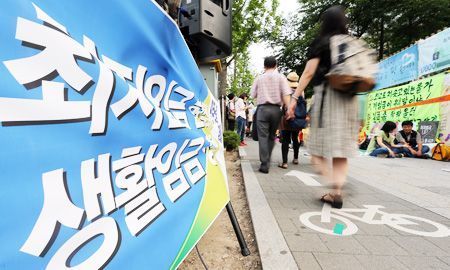
Members of the Korea Confederation of Trade Unions stage a rally outside the office of the Minimum Wage Commission in Nonhyeon-dong, southern Seoul, Friday. The KCTU is demanding a 19.1 percent increase in the minimum wage to 5,790 won per hour for next year. / Yonhap
By Kim Jae-won
Representatives of labor and their employers are in a deadlock over the issue of next year’s minimum wages due to failure to narrow their differences.
According to the Minimum Wage Commission (MWC), nine commissioners from the workers’ side insisted on raising the minimum wage by 19.1 percent from this year to 5,790 won per hour.
However, employers’ representatives wanted to raise it 1 percent, or 50 won to 4,910 won from this year’s 4,860 won.
The commission failed to agree on the matter at their sixth meeting on Thursday evening, passing the legal deadline. The next meeting is scheduled for July 4.
The MWC is the administrative body, consisting of 27 commissioners ― nine each from umbrella union groups, employers’ associations, and neutral social organizations.
“It seems that it will take some more time before the two parties reach an agreement. Both sides show no signs of making concessions,” said Jeon Hae-seon, secretary general of the commission.
According to Jeon, the initial gulf between the demands of the two sides was just too wide, as workers insisted on raising it by 21.6 percent, while employers sought to freeze it.
Experts are urging them to reach a compromise ― a gradual rise of the minimum wage and compensating workers with other incentives instead.
“Regarding the purpose of the minimum wage guideline is to tackle poverty, I recommend they set up a comprehensive policy mixed with a gradual increase of the minimum wage supported by social insurance fees,” said Yoo Kyung-jun, a researcher at the state-run Korea Development Institute, in his report.
Yoo also fears that a drastic increase of the minimum wage may result in job cuts, in this current business environment where companies are already grappling with low domestic demand and plunging exports.
However, labor unions reject this argument saying it is a typical method of management to resist any attempt at sharing profits with employees.
“If an employee works eight hours a day paid with the minimum wage of 2013, he takes home 1 million won per month. It is less than two third of minimum income required to live on,” said the Korea Confederation of Trade Unions (KCTU) in a statement.
The KCTU accused employers of being “devils” because they take billions won of in annual income, where as labor continues to receive some very low incomes.