China set to change North Korea policy but slowly
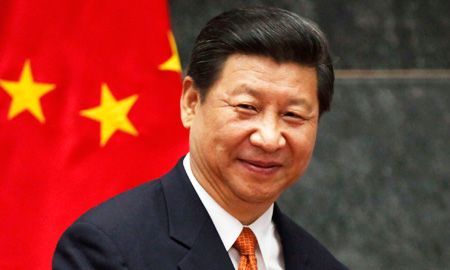
Chinese President Xi Jinping
By Kim Tae-gyu
BEIJING ㅡ Despite media expectations, the phrase “denuclearization of North Korea” neither came out from Chinese President Xi Jinping’s mouth nor appeared in a joint communique announced after his summit with South Korean President Park Geun-hye, Thursday.
Instead, he repeated China’s go-to phrase of “denuclearization of the Korean Peninsula” to disappoint some South Koreans who expected China to come up with stronger words this time in consideration of its recent anger toward North Korea’s nuclear ambitions.
However, Seoul still thinks that Beijing has shown a substantial adjustment in its relationship with Pyongyang, whose third nuclear test in February generated global criticism, including from its only benefactor and major aid supplier ㅡ China.
“China would not change its phrase overnight from ‘denuclearization of the Korean Peninsula’ to ‘denuclearization of North Korea.’ If you understand the country, you are not supposed to expect such an abrupt change,” a Cheong Wa Dae official said.
“We did not even attempt to urge China to accept such a change. We strived to ensure China’s shift in its practice toward North Korea rather than the words. In that sense, I think we were successful.”
A Seoul diplomat said that China, practically the only country that can influence the recalcitrant North Korean regime, has shown quite a different attitude and approach toward the North compared to the past.
“China is not a speed boat, which can maneuver swiftly any time. It is like an aircraft carrier, which needs quite a long time to change its direction,” said the diplomat who played a major role in drawing up the communique.
“Once an aircraft carrier changes its direction, however, it hardly returns to its old route. Those are what our Chinese partners talked about during the negotiations. I think their remarks mean something.”
However, some observers did not agree with the officials.
“The communique says that just South Korea, not China, expresses concerns on the continuing nuclear tests in North Korea. China just repeated its hitherto demands of denuclearization of the Korean Peninsula,” said Chang Yong-seok, an analyst of the Institute of Peace and Unification Studies affiliated with Seoul National University.
“And then China urged neighboring countries to grapple with the North Korean problems through dialogue at the six-party talks. I cannot see any change in its stance toward Pyongyang. We have heard of those so many times.”
Indeed, Beijing has been under criticism that it remains on the fence between North Korea and its neighbors, which press the Stalinist state to stop nuclear programs.
Although Beijing has upped its pressure on Pyongyang in the aftermath of a long-range missile launch last December and the nuclear test this year, critics claim that it is still failing to meet global expectations.
For example, Bruce Klinger, a senior researcher at the Heritage Foundation, said in a recent contribution to The Korea Times that Beijing does not assume its role in a full-fledged manner.
“Beijing has changed its policy toward Pyongyang though far less than most China watchers believe. It has strengthened its rhetoric and implemented some sanctions and measures, similar to what it did in the mid-2000s before later loosening them,” said Klinger, who served as the CIA’s deputy division chief for Korea analysis.
“Despite reports of Chinese anger at North Korean provocations, Beijing continues to simply advocate a return to the six-party talks, despite Pyongyang’s repeated assertions that it will never under any circumstances abandon its nuclear weapons.”