Did President know about it?
Summit minute disclosure puts Park on offensive
By Jun Ji-hye
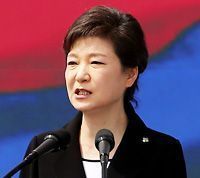
President Park Geun-hye
How was President Park Geun-hye involved in the disclosure of the 2007 inter-Korean summit minutes?
Did Park order it? Did she receive a report from the National Intelligence Service (NIS)? Or was she not aware of it? At least for now, there can’t be any way of knowing exactly what role she played.
The main opposition Democratic Party (DP) claimed that if she didn’t know, it was tantamount to a coup by the spy agency’s chief Nam Jae-joon.
Nam, a former Army chief of staff, said that he told neither Park nor the ruling Saenuri Party. The NIS normally directly reports to the President.
But one thing that is sure is that Park has benefited the most from the NIS declassification of the six-year-old minutes.
On Monday morning, she had to defend herself from allegations that the spy agency had tried to influence the outcome of the Dec. 19, 2012 presidential election for her. “I didn’t receive any NIS help,” she declared.
That afternoon, Nam made public the minutes, after some Saenuri Party lawmakers claimed that the late liberal President Roh Moo-hyun tried to renounce the Northern Limit Line (NLL), the de facto borderline in the West Sea, during his meeting with the late North Korean leader Kim Jong-il.
The Saenuri Party has been on the offensive, arguing that Roh tried to curry favor with Kim, didn’t act like a leader and attempted to abrogate the NLL.
The conservative forces were galvanized with three big newspapers, all right to center in editorial tone, jumping on the bandwagon.
This represented a sea change from row after row of buses carrying riot police who were mobilized around downtown Seoul in case college students’ small-scale demonstrations got out of hand.
A lesson or two has apparently been learned from Lee Myung-bak, Park’s predecessor, who was almost toppled in the face of months of candlelit protests over his decision to resume U.S. beef imports.
They too started on a small scale.
An associate of Lee’s didn’t deny it, when asked whether Park was a couple of moves ahead of Lee as far as political acumen was concerned.
He said that he was not in a position to know whether Park was any way involved in a decision-making process.
“Rightly or wrongly, the situation has been rapidly switched following the NIS disclosure of the transcripts of the summit that amplified the controversy regarding the late Roh’s alleged denial of the validity of the Northern Limit Line (NLL),” said Bae Jong-chan, a director at the department of social research at Research & Research.
Here are a couple of noteworthy facts.
Won Sei-hoon, former NIS chief, was indicted by the prosecution without physical detention on June 14 on charges of allegedly intervening in the Dec 19 presidential election.
Seoul National University denounced the NIS and the government for their alleged undercover cyber campaign to discredit then opposition candidates including Moon Jae-in and Ahn Cheol-soo.
They called for President Park’s resignation.
The NIS decided to release the transcripts of two late leaders’ dialogue to the public and this rendered the situation completely changed.
“The strategy stressing the national security issue was successful in giving prominence to Park’s strength as a conservative president,” said Bae.
But it remains to be seen whether Park can enjoy this political turn of the tides.
Bae said the disclosure of transcripts containing Roh’s comments about the U.S. and Japan as well as the NLL will likely affect the nation’s relations with the allied countries, calling it a wrong decision that was no different from Wikileaks’ revelations.
Plus, there is an entanglement of arguments about the legality of the NIS decision. The spy agency claims that the transcripts were classified as a Class 2 secret, but decided to declassify them because many had already been made public.
The DP claims the NIS’s disclosure was an unlawful act as the documents are presidential records, which are kept secret for 15 years and require, under law, approval of more than two-thirds of lawmakers or a high court ruling to make them public.