Dolphin couldn't wait to be freed
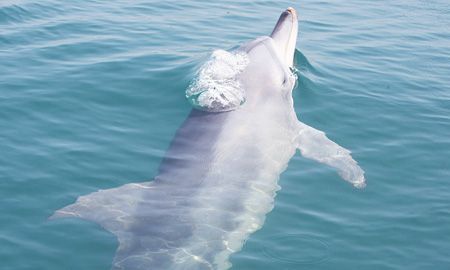
An Indo-Pacific bottlenose dolphin designated D-38, swims in an ocean pen in waters off Jeju Island, in this file photo taken on May 11. The dolphin was being adapted for life in the wild after four years captivity at a Jeju-based aquarium, but escaped Saturday. / Yonhap
By Nam Hyun-woo
A captive dolphin escaped from an ocean pen Saturday where it was being acclimatized for life in the wild. Experts said the fact that it chose freedom proves it has regained its survival instincts.
According to the Korean Animal Welfare Association (KAWA) Monday, the dolphin, designated D-38, fled the Seongsan Ocean Pen in waters off the Jeju Island, several weeks earlier than its scheduled release.
The 12-year-old Indo-Pacific bottlenose dolphin has been trained for reintroduction to the wild since it was transported from a Jeju-based aquarium on April 8. It performed at a dolphin show at the aquarium after it was captured illegally in 2009.
Trainers said the dolphin appears to have escaped through a 30-centimeter hole in a containment net. They suspect waves from Typhoon Leepi, which affected the island Thursday, tore the net. Divers had been routinely checking the pen, but the harsh weather prevented them from inspecting it last week week.
The dolphin stayed near the pen for about three to four hours before swimming toward open waters off the island, where over 100 Indo-Pacific bottlenose dolphins live in groups.
Kim Doo-nam, a research fellow at the National Fisheries Research and Development Institute, said the mammal’s escape from the pen is also an indication that it is ready to live on its own in the ocean.
“D-38 was healthy compared to other dolphins when it was moved to the pen. And the dolphin ate fish by itself, and did not have to be fed by hand,” she said.
Ric O’barry, an internationally renowned expert on cetacean reintroduction, also echoed Kim’s view. He said the escape should not raise concern, adding that the dolphin was in good health and returned to where it lived prior to its capture.
Kim said that the institute will try to find the location of D-38 and monitor its condition. “If we are lucky, we can take a photo of the dolphin, or at least track its whereabouts,” she said.
She added that the high temperature of waters off the island in summer were ideal for dolphins.
Two other dolphins, Jedol and Choonsam, remain in the pen after trainers lured them away from the hole immediately after D-38 was spotted outside it.
Choonsam was moved to the pen with D-38 from the Jeju aquarium and Jedol was transported from Seoul on May 11, garnering nationwide attention after four years of zoo life in the capital. The three were illegally captured together off Jeju.
KAWA said Jedol and Choonsam will be transported to another pen on the island before being released next month.
The experts said that rehabilitated dolphins sometimes follow fishing boats in order to be fed, but advised fishermen not to give them food so as to correct the habits they acquired during captivity.