Can Ahn flesh out 'progressive liberalism?'
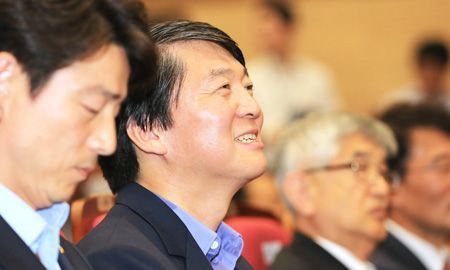
Independent lawmaker Ahn Cheol-soo, second from left, smiles during a forum held by his think-tank, named “Naeil,” at the National Assembly in Yeouido, Seoul, Wednesday. / Yonhap
By Kim Tae-gyu
Independent lawmaker Ahn Cheol-soo continued his political odyssey this week, addressing the first forum of his policy think-tank, “Naeil,” which means “Tomorrow”.
The former presidential candidate indicated that the purpose of the research organization is to eventually help establish a new political party.
“I didn’t think of making a new party just yet but I agree with that direction. I will flesh out the details. There also remain procedures through which specific contents should be presented,” said Ahn.
But his top lieutenants made no secret of their intention to form a new party that could reshape the long-lasting political landscape dominated by the conservative Saenuri Party and progressive Democratic Party (DP).
Leader of “Naeil”, Choi Jang-jip, an emeritus professor at Korea University, described the envisioned new party’s basic ideological goal as “progressive liberalism.”
“We propose pluralism instead of the past dichotomy between democratic and anti-democratic groups or one between conservative and pro-North Korean factions,” Choi said. “Progressive liberalism is the right ideology to realize our target.”
Choi said that progressive liberalism is about addressing various problems such as economic polarization and social inequality, caused by neo-liberalism and extreme free market fundamentalism policies.
The definition of the term “progressive liberalism” is elusive. But by and large, it is a more left-leaning approach than previous forms of liberalism.
Unlike neo-liberalism, which heralded the advent of modern-day laissez-faire capitalism, progressive liberalism seeks balance between the freedom of individuals and government interventions.
To realize this goal, the liberal icon famous for his progressive political opinions stressed the necessity of a new party, which will prioritize labor issues and the so-called economic democratization.
During a discussion on economic issues, Prof. Kim Sang-jo from Hansung University said that the country should reform large-sized conglomerates so that the market economy will be able to take a firm root in a fair way.
Welfare policies were also discussed on how to upgrade the way the country helps socially and economically marginalized people.
As confirmation of Ahn’s political clout, DP Chairman Kim Han-gil and Rep. Kim Moo-sung from the Saenuri Party attended the forum.
New party’s ideological stance
When Ahn entered the National Assembly this April by winning in a by-election, some expected that the 51-year-old would eventually join the DP because an independent congressman can make little headway in the 300-seat parliament.
Now, few seem to think so as support for the DP remains low.
“The consensus is that Ahn will establish a party before the local elections next year. There still is a possibility that he will join the DP but this is a somewhat unlikely idea that few believe right now,” said Korea Society Opinion Institute official Yoon Hee-woong.
“Ahn has said that he wants to encompass both progressive and conservative ideas. This means that he should not become a member of the DP. Things might change ahead of elections but not now.”
However, observers point out that there are many potential stumbling blocks in Ahn’s maneuvering to introduce new-style politics different to conventional ones that are liable to confrontations and conflicts.
In particular, he said that a new party cannot be unilaterally categorized as a progressive one at a recent meeting with journalists. During the presidential election last year, he also put forward similar points of view.
This might end up causing some discord with one of Ahn’s top aides, Choi, who cares more about issues such as labor relations, traditionally a concern of the left.
“I 100 percent agree with Choi who said the party has to reflect the voices of ordinary people, workers and the self-employed. But this does not necessarily mean that I will organize a progressive party,” he said.
“For example, national security might be different from labor policies. If I define the new party as progressive, my arguments regarding security might fail to persuade people.”