'Mini-households' multiply
By Kim Jae-won
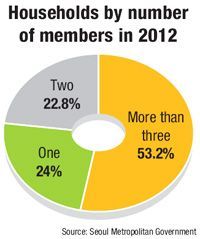
Households in Seoul have fewer members and these “mini-households” with of two people or less are not as happy as bigger ones, a survey released Monday.
According to the survey conducted by the Seoul Metropolitan Government in October of 20,000 households in the city, 46.6 percent of households have one or two members, up 4.4 percentage points from 2005.
Twenty-four percent of respondents lived alone, while two-people households accounted for 22.8 percent.
However, living alone or with a partner seemed not so fulfilling. Their average happiness index marked 64.5 and 66.7, respectively, on a scale of 100, while households with three or more members reached 68.6. The score is based on their responses to multiple questions on happiness.
“People living alone or with a partner lack relationships compared to others who live in big families. This is the main cause of the difference in their happiness,” said Cho Young-sam, a director at Seoul city government.
Of one-person households, those in their 30s took up the largest share at 48.1 percent. The majority of the heads of two-member households, or 44.7 percent, were those in their 60s or older, according to the survey.
In a separate survey of 2,500 foreigners residing in Seoul for at least for three months, their satisfaction level with their life in the city came to 6.82 out of 10. Convenience in using public transportation earned the highest score of 7.44 points, followed by desirable living circumstances with 7.29 points, overall safety with 7.2 points and good education environments with 6.8 points.
However, more than a quarter of foreign residents in Seoul said that the language barrier was the most difficult thing to deal with in the city. Eighteen percent of them said that loneliness was a big challenge, followed by economic difficulties (12.8 percent), difference in culture (8.6 percent) and discrimination (6 percent).
The monthly income of households in Seoul has risen, but more than half of them are saddled with debts due mainly to high housing costs amid the country's faltering real estate market, according to the survey.
Sixty-five percent of the households said they earned more than 3 million won ($2,660) per month, up by 5.8 percentage points from a year earlier. But 50.9 percent of respondents said they were in debt, with the largest share, or 60.5 percent, citing expenses either to buy or rent a house as the main cause.