S-N tug of war lasts 18 hours
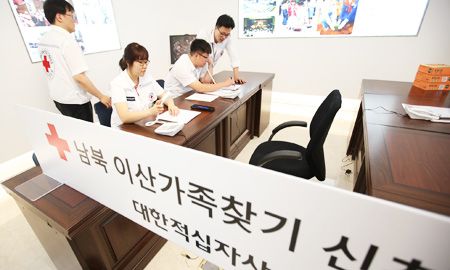
Members of the Red Cross test the inter-Korean communication line at the office in Seoul, Monday. The line was restored last week following North Korea’s offer to hold a government meeting to discuss resuming reunions of family members separated by the Korean War (1950-1953), among other issues. / Yonhap
By Kim Tae-gyu
It took 10 meetings in over 18 hours of working-level talks for the two Koreas to agree to hold an inter-government meeting in Seoul on June 12 and 13.
The talks began Sunday and continue through early Monday.
South Korea’s chief negotiator Chun Hae-sung met with his North Korean counterpart Kim Song-hye at the truce village of Panmunjeom at 10:13 a.m. Sunday.
The two focused on practical issues to lay the groundwork for the high-stakes meeting.
Initially, Unification Ministry spokesman Kim Hyung-suk said that things went smoothly in the morning sessions.
But the hopes of early and easy agreements waned as the two sides struggled to grapple with repercussions of the long-lasting impasse in inter-Korean relations ― they suffered from abysmal ties over the past five years under the former conservative President Lee Myung-bak.
They failed to iron out differences in such details as the size of the delegation and the agenda. One of the thorniest topics was who will lead the delegations at the meeting.
Seoul asked for Kim Yang-gon, head of the ruling Workers Party’s United Front Department, to represent the North’s delegation to meet with Unification Minister Ryoo Kihl-jae.
However, Pyongynag was negative about the proposal because those in Kim’s position have never participated in a minister-level meeting.
Worries arose that the negotiations might fall apart because leaders of the lower-level meeting failed to find a happy medium and the talks continued into the night.
Chun and Kim finally struck a deal during their 10th meeting that started at 2:35 a.m. and finished 3:05 a.m. Monday but it was incomplete. Hence, the two opted to announce separate statements without touching on sensitive issues.
Five delegates from each country will meet in Seoul to deal with the reopening of the closed inter-Korean Gaeseong Industrial Complex, tours to Mt. Geumgang and reunions of families separated by the Korean War (1950-53).
But the level of chief delegate and other specific issues have not been fixed yet. At issue is the denuclearization of North Korea ― Seoul wants to raise this but Pyongyang is dead set against it it.
Through three nuclear tests in 2006, 2009 and early this year, the North did not make it a secret that it was trying to become a full-fledged nuclear power, and under the Lee administration the South refused talks without the North giving up such ambitions.
Incumbent President Park Geun-hye also requested a nuclear-free Korean Peninsula but she did not close the door to talks even though the North may not abandon its nuclear programs.
Despite such a policy shift, inter-Korean relations were frayed this year due to the North’s Feb. 12 nuclear test, and the rising tensions led to the closure of the Gaeseong complex, the last remaining major symbol of inter-Korean rapprochement, this April.