'Northeast Asian community is not a distant dream'

This is the UNESCAP-ENEA building opened two years ago in Songdo, Incheon. / Courtesy of UNESCAP-ENEA
Director of UNESCAP accents regional integration
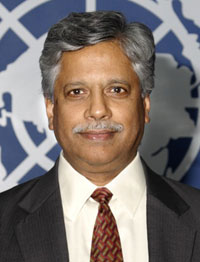
Kilaparti Ramakrishna, director of UNESCAP-ENEA
By Kim Se-jeong
The head of the United Nations body promoting economic, social and environmental development in Northeast Asia takes pride in his organization’s mission to promote regional integration.
Kilaparti Ramakrishna, director of the U.N. Economic and Social Commission for Asia and the Pacific in East and Northeast Asia (UNESCAP-ENEA), said that his organization has compelling reasons for building a Northeast Asian Community.
“The economic crisis clearly demonstrates the region can no longer rely on ‘business as usual,’” Ramakrishna told The Korea Times.
Northeast Asia is home to two of the world’s biggest economies; together with Russia and Korea, the region has four of the world’s 20 largest economies.
He has called for orchestrated and speedy action to address pressing issues such as climate change, water and energy, stressing the importance of regional cooperation.
The issue of regional integration is a delicate issue in Northeast Asia. Although many agree in principle, history and contemporary issues have obstructed the idea from moving forward.
“People often say it’s impossible,” Ramakrishna said acknowledging the deeply-rooted pessimism apparent among some quarters.
He noted that realizing regional integration is not a distant dream, although the history of the region shows that it is striving to achieve that goal.
Japan occupied the Korean Peninsula for 35 years in the early 20th century. It went to war with both Russia and China.
To make things even worse, during World War II, Japan forced countless women from Korea, China and other Asian countries into sex slavery, the victims of which have sought compensation.
More recently, Japan has found itself in hot water with Korea, China and Russia over a territorial dispute. In addition, North Korea keeps the region divided as it pursues nuclear weapons and threatens its neighbors for putting constraints on doing so.
Ramakrishna added, “History of regional integration tells us that the formation of a strong regional community will take many years of positive interaction and trust-building and that progress will be slow.”
And generating positive interaction and trust-building is what his office does.
One good example is a senior officials’ meeting on the environment held last December in Cheongdu, China.
The office invited officials from North and South Korea, Japan, China, Russia and Mongolia for a two-day meeting where they exchanged views on air pollution, marine environment, mitigation of dust and sand storms, and eco-efficiency partnerships.
The meeting came while sovereignty disputes over islands involving Japan and China were making headlines; and the inter-Korean relations were again strained by the launch of a rocket from the North. Yet, the meeting continued, he recalled.
He calls for an interaction in a wide range of issues.
“With increasing interactions of sub-regional countries on a wide range of areas, it’s possible to work toward building a strong and coherent Northeast Asian Community,” he said. “A number of factors that connect and link the region are far more numerous than what separates and divides the sub-region.”
Development projects
The integration process includes the provision of development assistance to North Korea and Mongolia that are currently lagging behind other countries in the region.
With North Korea, the extent of cooperation is limited due to the regime’s provocations.
Welcoming an agreement to hold a ministerial meeting between the two Koreas, Ramakrishna hoped to realize an energy infrastructure project with North Korea, possibly in the Gaeseong Industrial Complex.
With the meeting scheduled for Wednesday in Seoul, there is guarded optimism about resuming operation of the shutdown inter-Korean industrial complex.
The complex housed more than 100 South Korean companies, employing almost 53,000 North Korean workers until it stopped operation on April 8 when the regime removed all the workers in a threat to South Korea which had joined in condemning the North for carrying out a nuclear test earlier this year and in enforcing sanctions.
The director was very cautious about elaborating on projects with North Korea. “When it comes to projects with North Korea, it’s not an issue and country, where I can make decisions here,” he said.
Previous projects include technical training for about 30 North Koreans in Bangkok last year. He said, the two will meet again soon for future development projects in the field of energy.
In Mongolia, there is the “Green Civilization” project.
UNESCAP provided policy consultancy to the government of Mongolia, which announced its plan on World Environment Day on June 5.
The extent of work with Mongolia is deeper and wider, given the openness of the country and its potential, compared to that in North Korea. Mongolia has made a steady growth rate for the last several years, and it has abundant mineral resources, especially coal appealing to foreign investors.
Ramakrishna lauded his organization for “customer-oriented approach,” not pushing the client unilaterally to adopt the given policy recommendation.
“We work together,” the director said, starting from pointing out what the client wants to drawing up tailored policy recommendations.
With Russia, the projects focus on development in Siberia.
With China, Korea and Japan, the organization’s main line of work is to offer consultancy in implementing the development policies in each countries. For example, “China has an aid budget that’s bigger than that for the OECD DAC members. To whom will they give money? That’s where we work together.” TheDAC is the Development Assistance Committee.
The DAC is a group of big aid donors under the OECD.
Kilaparti Ramakrishna is the director of the UNESCAP-ENEA. Before joining ESCAP, he was an international lawyer with expertise in the environment and a climate policy advisor. He is one of the authors of the Intergovernmental Panel on Climate Change.
He joined UNESCAP in 2011. His U.N. career began with the United Nations Environment Program where he served for five years as the principal policy advisor to the executive director of the organization.
His teaching experience has been at law schools including the Fletcher School of Law and Diplomacy, Harvard Law School, Boson University and Boston College Law Schools and Yale University.
UNESCAP works for regional development
UNESCAP is a regional development body of the United Nations for the Asia-Pacific region.
Established in 1947, with headquarters in Bangkok, Thailand, UNESCAP is working to confront challenges by offering projects, technical assistance and capacity building to member states in the areas of macroeconomic policy and development; trade and investment; transport; social development; environment and sustainable development; information and communications technology and disaster risk reduction; statistics; and sub-regional activities for development. It has 62 member states.
The UNESCAP-ENEA is one of the four sub-regional offices covering six countries: North and South Korea, Japan, China, Mongolia and Russia. Macao and Hong Kong are associate members.
Three other sub-regional offices are located in Fiji, Kazakhstan and India, and its headquarters in Thailand.