Is Ahn progressive or conservative?

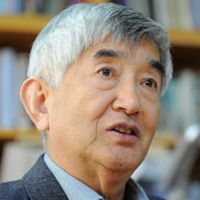
Rep. Ahn Cheol-soo
Ex-presidential candidate clashes with advisors
By Jun Ji-hye
Even before launching his own party, independent lawmaker Ahn Cheol-soo is currently involved in ideological conflicts with his key advisors.
Ahn made it clear that he will not create a party that upholds a progressive ideology.
He spoke to journalists Monday after Choi Jang-jip, an honorary professor of Korea University who recently joined Ahn’s policy think tank, said that Ahn’s party will take a progressive course and deal with labor issues as a core political issue.
The former presidential candidate said he does not want to become locked into a singular direction political track.
“I totally agree with Choi who said the party should reflect voices of ordinary people, laborers and the self-employed. But this does not mean that I will organize a progressive party,” Ahn told reporters during a lunch at a restaurant near the National Assembly.
“For example, the national security issue could be different from labor policy. If I characterize the party as progressive, my argument regarding security would lack persuasion,” said Ahn.
In the run-up to the Dec. 19 presidential election, Ahn suggested that he would adopt a progressive position regarding economic issues and a conservative line for security matters.
In contrast, Choi, chairman of the board of Ahn’s policy think tank “Naeil,” which means tomorrow, said existing parties have not spoken properly for those marginalized from society.
“A new party that will represent laborers and the lower classes is definitely necessary in this nation,” said Choi in a seminar dubbed “Ahn Sensation and the Future of the Democratic Party (DP),” Monday.
Choi, a noted progressive political scientist who has studied labor issues and the roles of political parties in democracies, also had said late last month that Ahn’s party should adopt progressive policies.
Some experts expressed concerns that pursuing a progressive line could weaken Ahn’s support base that has absorbed middle-of-the road or independent voters.
“Choi’s argument is not able to embrace the reform-minded middle class who aim for progressivism regarding democratization of the economy, while preferring conservatism regarding inter-Korean policy. But these people are a major support base for Ahn,” said Pyo Hak-kil, an economics professor at Seoul National University, during his appearance at Monday’s seminar, along with Choi.
Meanwhile, Ahn engaged in all-out competition with the DP, also on Monday, by holding an open forum on labor issues at the same time and next door to a conference room in which the DP conducted a similar meeting.
Ahn earlier said he is willing to expand his political power by recruiting talents who will run in the October by-elections in which about 10 parliament seats will be contested.
In his first ever forum since his entry into the Assembly in April, dubbed “Listen to Vivid Voices about Problems on People's Livelihood,” he said: “We arranged this occasion to draw up institutional and legal measures to control unfair trading practices in distribution industries.”
In the next room, the DP’s internal group, “Progressive Politics Solidarity for Welfare State,” held another forum dubbed: “Strategy for DP’s Return to Power _ Becoming Party for Working People.”
“In order for the DP to come back to power, labor policy that is able to embrace all regions and generations is necessary,” said Park Yong-jin, DP’s spokesman who chairs the group.
Park stressed labor issues should be established as a significant subject within the DP, in what is seen as a tit-for-tat over Ahn’s recent move to expand his influence.
Rep. Jun Byung-hun, DP’s floor leader, invited Ahn to his office Tuesday and suggested that the relationship between Ahn and the DP in the Assembly should be “cooperative partnership,” so the two sides can together push forward with policy for the unprivileged in society.