Conservative cable TVs draw fire
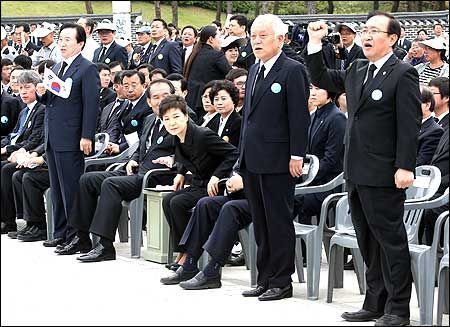
President Park Geun-hye stands up as participants sing “Nimeul Wihan Haengjingok” (March for the Beloved), a representative protest song, during the official ceremony of the 33rd anniversary of the Gwangju Democratic Movement in the National May 18 Cemetery in the southwestern city, Saturday. Democratic Party Chairman Kim Han-gil, second from right; Roh Hoe-chan, right, co-chairman of the Progressive Justice Party; and Gwangju Mayor Kang Un-tae, left, sing the song. The state-run organizing body had a choir sing the song, while opposition parties demanded all participants in the ceremony sing in unison. Two conservative cable news channels drew criticism for broadcasting programs that claimed North Korean infiltrators were behind the movement. Yonhap
Opposition, civic groups refute claim linking NK with Gwangju Movement
By Kim Jae-won
Two conservative news cables face a backlash over their claim that the North Korean military was behind the May 18 Gwangju Democratic Movement quelled bloodily by then military junta in the southwestern city in 1980.
Politicians and civic groups criticized TV Chosun and Channel A for broadcasting programs claiming that about 600 soldiers dispatched from North Korea led the uprising. The two channels are run by leading conservative newspapers the Chosun Ilbo and the Dong-A Ilbo, respectively.
“The May 18 Gwangju Democratic Movement is a righteous uprising which stood up against a military junta that destroyed democracy and human rights. However, it is worrisome that some groups deny this and attempt to manipulate history, following in the footsteps of Japanese right wingers,” said Park Yong-jin, spokesman of the main opposition Democratic Party.
The movement refers to a people’s uprising in Gwangju from May 18 to 27, 1980. During this period, citizens rose up against the dictatorship of then-major general Chun Doo-hwan and took control of the city.
However, the revolt in the city was immediately violently crushed by the junta, resulting in the deaths of hundreds of people. During Chun’s presidency in the 1980s, the incident was misrepresented by the media as a rebellion inspired by communist sympathizers.
Commentators lashed out at the cable broadcasters, saying they were no better than Japanese ultra-right wing politicians who manipulate history for their parochial interests.
“Channel A defamed the Gwnagju Democratic Movement. This is disgusting to give up responsibility of the media to get more audience ratings, though they suffer from low ratings,” said Cho Kuk, professor of Seoul National University’s law school, through his Twitter account.
Rhyu Si-min, a former politician and best-selling author, criticized the broadcasters for missing the proper attitude of people.
“I hope people who died during the movement rest in peace. And those who defame the spirit of Gwangju should learn the right attitude of human beings.”
Meanwhile, President Park Geun-hye took part in the official event commemorating the 33rd anniversary of the democratic movement at the May 18 National Cemetery in the city. It is the first time since 2008 that the president has attended the ceremony.
Park said she felt the loss and sorrow felt by relatives of people killed during the Gwangju democracy movement and pledged to use the spirit of the movement to transform the country into a country that people can feel proud of.