'N. Korea will pay price for any hostility'
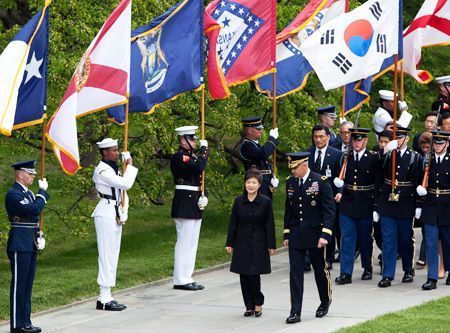
President Park Geun-hye, escorted by Maj. Gen. Michael Linnington, walks past the colors of American states during a wreath-laying ceremony at the Tomb of the Unknowns at Arlington National Cemetery in Arlington, Va., Monday. / AP-Yonhap
Park vows to break pattern of rewarding bad behavior
By Kim Tae-gyu
WASHINGTON — President Park Geun-hye said Monday (local time) that North Korea will “pay the price” for any hostility.
“We will make them pay,” she said during an interview with CBS here, when asked what she would do, if the North made even small-scale provocations.
Park said that she will end the past pattern by which North Korea is eventually rewarded by South Korea and the United States for its hostile acts.
“North Korea makes provocations. This is followed by negotiation and then assistance. And so we saw a perpetuation of this vicious cycle. It is time for us to put an end to it,” she said.
Pyongyang enraged most of the world by carrying out a missile test last December and a third atomic test on Feb. 12, prompting strengthened U.N. sanctions.
U.N. Secretary General Ban Ki-moon said that humanitarian aid should continue in an earlier meeting with President Park in New York.
Park, who is in the United States on her first overseas trip following her inauguration, agreed that weaker North Korean citizens should get outside assistance.
“From the long-term perspective, I think that North Korea is a sort of a national burden that South Korea should brace for,” Ban said in the meeting held at U.N. headquarters.
“In particular, I think that it is necessary to keep helping North Korea’s infants and economically marginalized people in consideration of South Korea’s status and politics and from a humanitarian aspect,” Ban noted.
He added that the global society has been reluctant to support North Korea so that the growth of up to 30 percent of the country’s children aged less than five is stunted.
The former foreign affairs minister of South Korea said that the situation was quite bizarre — the U.N. is rich in cash reserves accumulated for emergencies but they cannot be funneled to North Korea because of the uncertainties of the reclusive regime.
“I am worried that this might greatly weigh on South Korea after reunification,” he said.
President Park concurred.
“For North Korea’s children and underprivileged, I also think that we’re required to offer humanitarian assistance,” she said.
“It would be ideal if we could join forces with the United Nations to help in a transparent way those who desperately need the assistance.”
Park said that humanitarian aid should not be stopped unlike under her predecessor former President Lee Myung-bak.
This is a kernel of her flagship “Korean Peninsula Trust Process” policy aimed at engaging the isolated Stalinist state through building trust between the two Koreas.
It contrasts to former President Lee, during whose presidency the inter-Korean relationship hit the rock bottom as the businessman-turned-politician stressed only the principle that there would be no aid without denuclearization.
Park and Ban were meeting for the first time since August 2009 when she visited Europe to accelerate the signing of a free trade pact between Korea and European Union.